
Confession-Driven Missions

Note: This book review first appeared in Credo Magazine.
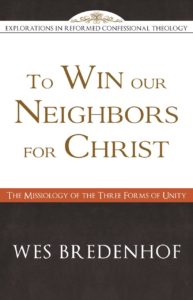

The “Three Forms of Unity” mentioned in the subtitle to Bredenhof’s book, To Win Our Neighbors for Christ: The Missiology of the Three Forms of Unity (Reformation Heritage Books), is the collective name given to the Belgic Confession (1561), the Heidelberg Catechism (1563), and the Canons of the Synod of Dort (1619). Along with the ecumenical creeds, these constitute the confessional documents of the churches that lie downstream of the Dutch and German Reformed Reformations. (Don’t panic if you don’t know which they are; you can almost always pick them out by noting the word “Reformed” in their denominational designations.)

If you’re unfamiliar with these documents, you should get to know them. They provide as exemplary a conjunction of precise theology, pastoral wisdom, and personal piety as you’re likely to encounter anywhere—and all the more so among confessional documents!

If you do know the Three Forms (or if you think you know them), you’ll perhaps be surprised to learn that they have a missiology. After all, missiology textbooks typically make the claim that the Reformation produced no missionaries but rather a lingering “missions-lukewarmness” (p. ix). Rather, they assert, the age of missions began in earnest only after the publication of William Carey’s Enquiry into the Obligation of Christians to Use Means…. (1793) and only in the nineteenth century did missiology begin to develop into a distinct discipline. By contrast, the Three Forms never even mention “missions” or “missiology.”

I have to admit that I was curious about the types of argument the author would be able to muster, and when the book arrived I had to restrain a chuckle. Perhaps the size—ninety-three smallish pages of text—suggested that there really wasn’t much to say on this topic. I stand corrected. Thanks to To Win Our Neighbors for Christ, I now find myself reading the Three Forms with clearer and, if you will, more missiologically attuned eyes, for the book’s basic argument is compelling, even if that argument raised more questions in my mind than it answered.

Let me back up. Bredenhof does two things in this book. First, he argues that we’ve misunderstood (or, rather, failed to notice) the missiology of the Three Forms because most modern readers have a different understanding of what missions are than did the authors of the Three Forms. Yet, he suggests, the older approach to missions is coherent, robust, and biblically rooted. Second and consequently, because their confessional documents have a thoroughgoing missiological agenda, churches that subscribe to them must reflect that “outward orientation” (p. 86). If the first point is correct, I take it that the second one follows almost necessarily.

So, how does Bredenhof re-read the missiology-less Three Forms as missiological texts? The answer is: excavation. He uncovers the layers of meaning that lie hidden in comments and citations that we pass over without recognizing their full significance. He explains that their authors and audience understood themselves to be living in what we might now call an active missions field, one composed of neighbors who gave their religious allegiance to the theology codified at the Roman Catholic Council of Trent (1545-63). For example, the martyred author of the Belgic Confession understood “the Reformed faith as the only path to salvation” and that “to turn one’s back on that faith [was] to be lost” (p. 12). Therefore, to confess the truth of the gospel with the church was to testify to that gospel to the world and to invite those who were outside to come in.

As this suggests, Bredenhof argues that the Three Forms collapse any substantive distinction between evangelization and missions (pp. xii-xiii). In effect, the reason why we don’t recognize the missiological agenda of the Three Forms is because we tend to assume that missions are either tangentially related to the work of churches “back home” with their elders and deacons and formal church membership or that such structures have no bearing on the work of trailblazing lone-wolf missionaries. By contrast, the missiology of the Three Forms demands that the ongoing proclamation of the gospel by word and deed to immediate neighbors and to all the nations of the world be a work of the “established church” (p. 37).

Unfortunately, Bredenhof’s argument is too brief to demonstrate this conclusion, and the whole project deserves a lot more development and contextualization than it gets. In the author’s defense, he did publish a longer book just on the Belgic Confession that excavates that document more thoroughly. Even so, we are largely left to wonder whether the Three Forms did, in fact, motivate early modern Christians whose theology, piety, and practice were shaped by them to pursue missionary activity beyond the bounds of the Netherlands.

While Bredenhof offers several examples of modern-day missionaries using the Three Forms in their labor and even briefly refers to the Dutch effort to proselytize in seventeenth-century Brazil, the evidence marshaled is underwhelming. We’re left to wonder whether the Three Forms really motivated contemporaries to spread the gospel to the ends of the earth. (By the way, they did… but it’s a complicated story that involves the role of the Dutch in the first great wave of globalization from about 1450 to 1800.)

So, what should we make of this? I’ll offer two takeaways worth pondering.

First, Bredenhof raises challenging questions about the way that we conceptualize missions and the Great Commission in a post-”great age of missions” world. There are many good things to say about William Carey, but one of the unfortunate (and unintended?) legacies of his bombshell Enquiry is that it has produced a vision of missions that divides the effort into goers and senders—the real missionaries and those back home who do their bit by offering up money and prayers. Bredenhof helpfully reminds us that the whole church is called to confess Christ before our neighbors that we might win some (1 Cor. 9.22).

Second, many of us in the West have recently realized just how far our own society has drifted away from Christian moorings. What appeared to be a slow veering off course has suddenly accelerated in unexpected and uncomfortable ways. I was struck by the fact that, in this, we are more like our sixteenth-century forebears than we might have imagined. They too awoke to find themselves surrounded by opposition to the gospel. Their success in navigating those treacherous waters is closely connected to the fact that their churches produced and rallied around confessional documents like the Three Forms of Unity. They functioned as a Rule of Faith, a clear articulation of the heart of the apostolic gospel message for their context. We would do well to follow their model. Let’s take another look at these Reformation documents and see if they don’t help us collectively confess where we stand, both at home and abroad.

Systematic Theology I: The Revelation of the Trinity (Video 4)

This Fourth video from the Systematic Theology I course that I taught in S. Asia deals with the question of when was the Trinity revealed. It’s a fascinating topic, and that has drawn me in more and more as I’ve thought about it.

You may have noticed that nowhere in Scripture does God shout down from heaven and say, “Hey! I’m three persons in one essence!” Instead, our triune God does something even more remarkable. He reveals that he is Father, Son, and Spirit as he acts in history to save a people for himself when the Father sends the Son and when the Father and the Son send the Spirit.

One theologian commented that the revelation of the Trinity is not so much heard in Scripture as overheard. It’s the sort of thing that the Old Testament is always pointing forward to and that the New Testament is always looking back at. Why? Because God most fully revealed himself as Father, Son, and Spirit in between the two testaments. Wow.

By the way, if you want to read something good on this stuff, take a look at (the inimitable) Fred Sander‘s work. The Triune God is dense but rich. He wrote The Deep Things of God at a more popular level. Both are great.

Systematic Theology I: Being and Knowing (Video 3)

This is the third video (of fifteen!) that I made for the ST1 course that I recently taught for a school in S. Asia. The topic here is, broadly, “Being & Knowing” as the title suggests, but this takes us into such load-bearing elements as the Creator/creature distinction, general & special revelation, archetypal & ectypal knowledge, etc. Enjoy!

Systematic Theology I: Heads of Doctrine (Video 2)

Here’s the second video for the Systematic Theology I course that I recently taught remotely for a school in S. Asia. In this video (the second of the course) I discuss why we might want to study systematic theology and also what sort of things we talk about in systematics—what we sometimes call “heads of doctrine.”

One “heads” up. This video and the previous one had some audio issues toward the end. Not at all sure how or why but the recording cuts out just as I’m saying goodbye. Not much content is lost, but it is annoying.

Systematic Theology I: Introduction (Video 1)

In March I was honored (really!) to get to teach the first of three systematics course for a school that we partner with in S. Asia. I could spend hours telling you how amazing these guys are and how much I believe that the work they are doing will have a lasting impact. Don’t worry, I won’t.

Thanks to COVID, we’ve had to do a lot of things differently over the last year. One pivot is that we’ve countenanced the idea of teaching remotely. Part of the remote teaching regiment for this school is that we send a series of videos to explain or dive more deeply into some of the issues that the course covers.

I’m gonna put the (fourteen!) videos for this course online. Just a special bonus for visiting. Not only did I get to record and edit them, I also got to watch them. I feel fairly confident that I have not intentionally espoused or taught heresy. But I did

This video is an introduction to the course. I had to trim the beginning to remove information that identified the location of the school, so it starts abruptly. If you’re going to skip a video, this is the one, since I’m mostly just introducing textbooks. Boring! Alternatively, you can watch it at 2x speed, which is what I do.

The Mission Field in Our Back Yard

[Note: This article first appeared on the Gospel Coalition.]

As of 2017, more than a quarter of a billion people worldwide lived outside their country of birth. In the United States, Canada, and abroad, this is big news—the stuff of political wrangling and late-night talk show monologues. The global movement of peoples is at an all-time high, with the West as a preferred destination. This presents an unprecedented opportunity for the church. In fact, it’s so convenient that many may initially fail to recognize it as real missions work. But before dismissing it, we should consider how Christians have engaged this issue in the past—both our mistakes and our successes—for while the number of people in this global movement is greater than ever before, the gospel has spread to and through diaspora communities from the beginning.

When we read Jesus’s Great Commission, most American Christians picture the modern missions movement. Our minds quickly jump from the first century to the 19th and 20th, to William Carey, Hudson Taylor, David Livingstone, Amy Carmichael, Jim and Elisabeth Elliot, Eric Liddel, and many others who carried the gospel abroad. Generations of Western believers were reared on their stories; their biographies still shape our reading of biblical passages about reaching the nations.

“Taking the gospel to the ends of the earth has never been simply about God’s people going from here to there; it’s also been about ministering to those who’ve come from there to here.”

But there’s an obvious kind of chronological shortsightedness to this vision of missions, since the church has sent out evangelists and gospel workers in every century, from the first to the 21st. There is also a misconception that has to do with coming and going. Taking the gospel to the ends of the earth has never been simply about God’s people going from here to there; it’s also been about ministering to those who’ve come from there to here.

From There to Here

Acts tells us about the apostles preaching to, baptizing, and discipling “devout men from every nation” who had come to Jerusalem for the festival of Pentecost (Acts 2:5). From the moment God’s Spirit was poured out on the church, Jesus’s disciples began to carry out the commission they’d received from him by ministering among the diaspora in their midst.

These “devout men” included both Jews and also proselytes who were drawn to the Jewish religion. And while some of these new converts lived within Jerusalem, Luke highlights the group’s cosmopolitan breadth. They came from all over the known world—the Near East, Asia Minor, the Levant, Mediterranean Crete, North Africa, Arabia, and Rome, as well as the Iranian Plateau, the Caspian Sea region, and Mesopotamia in the Parthian Empire (Acts 2:9–10). At Pentecost 3,000 of these pilgrims were baptized and added to the church.

Rather than returning to their homes after Pentecost, it seems these new believers remained in Jerusalem to be discipled. They lived in close community and gave themselves over to learning from the apostles, to fellowship, to the breaking of bread, and to prayer (Acts 2:42). Despite receiving tastes of future persecution, the Christians spoke God’s word boldly, provided for those in need, and “were of one heart and soul” (Acts 4:31–34).

As desirable, even idyllic, as the description of that church sounds, we know there were problems. Among them were tensions between the Hellenistic (i.e., Greek-speaking diaspora) Jews and the Hebrew-speaking Jews from Palestine. Some of the latter were failing to care well for the congregation’s Grecian widows while showing greater generosity to their own (Acts 6:1). The apostles addressed the budding trouble by instructing the congregation to choose seven men who were then set apart for this diaconal work. Several were from abroad, including Nicolaus, described as a “proselyte of Antioch” (Acts 6:5). The apostles poured themselves into the whole community, including those sojourners in Jerusalem—everyone received instruction from the apostles (Acts 2:42).

To There Again

Stephen was among the seven who served in the church and, we learn, was a powerful evangelist. Perhaps a year after Pentecost, his arrest and martyrdom sparked a wave of persecution. Consequently, those living in Jerusalem, where they’d been baptized and discipled, “were scattered throughout the regions of Judea and Samaria” and carried the gospel as they “went about preaching the word” (Acts 8:1–4).

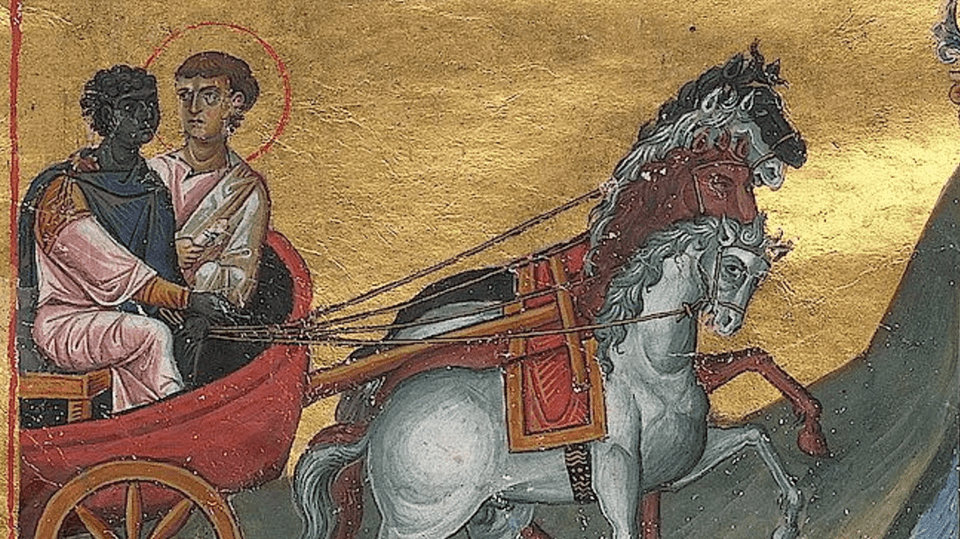
Philip and the Ethiopian Eunuch, Monologium Basilii II (10th c.)

Among those dispersed was Philip. To judge from his subsequent sphere of ministry—Samaria and maritime towns like Azotus (Ashdod) and Caesarea Maratima (Acts 8:4–8, 40; 21:8)—he may have been one of those sojourning in Jerusalem, perhaps a Grecian Jew or Samaritan. After the disciples were dispersed following Stephen’s death, Philip took the gospel to Samaria. Only subsequently did John and Peter travel north to support the fledgling congregation (Acts 8:14–15). Later led by the Spirit, Philip engaged in drive-by evangelism and roadside baptism: he delivered Christ to an Ethiopian eunuch who, tradition suggests, took the gospel into Sub-Saharan Africa. Thus, the apostles began fulfilling Jesus’s admonition to be his witnesses to the ends of the earth by ministering to and through the diaspora outsiders in their midst.

“Ministering to sojourners and foreigners was no sideshow for the early church. Apostles and first-generation Christians obeyed the Great Commission by doing diaspora ministry.”

And these outsiders became pivotal in spreading Christianity among the Gentiles. In Antioch, Jewish converts to Christianity who had sojourned in Jerusalem after Pentecost—“men of [the island of] Cyprus and Cyrene [in North Africa]”—preached Jesus as Lord among Greek-speaking non-Jews. The resulting church was shepherded by a group of “prophets and teachers” comprising principally non-natives: Barnabas (from Cyprus), Simeon called Niger (from Africa?), Lucius (Libyan Africa), Manaen (an old friend of Herod the Tetrarch), and Paul (from Damascus). Under their watch, the church at Antioch became a major hub of missionary activity throughout the Roman Mediterranean, perhaps even taking Christianity to Edessa, from where it entered the Persian Empire.

Take another example. Roman Jews were present in Jerusalem to hear Peter’s Pentecost sermon. Some were surely among those baptized that day, and likely returned to Rome after Stephen’s death, where Christianity began to grow among the Jewish community. In AD 52, Emperor Claudius expelled from Rome all Jews, including the tentmaking couple Aquila and Priscilla (Acts 18:1–2). When Paul came to Corinth, he located and lodged with them. We don’t know that they were Christians when Paul found them, but they soon became his co-laborers. They traveled to Ephesus, where they hosted a church in their home for more than three years (1 Corinthians 16:19; Acts 20:31). Later, they were back in Rome, where they hosted another house church (Romans 16:3–5). And most of Europe received the gospel as a result of efforts organized from Rome.

Serving Among the Ethne

Ministering to sojourners and foreigners was no sideshow for the early church. Apostles and first-generation Christians obeyed the Great Commission by doing diaspora ministry. It’s only a slight exaggeration to say imagining the early church without an active diaspora ministry is to imagine a church that stayed in Jerusalem and preached only in synagogues. It’s to imagine a church where Paul lacked a home base for missionary labors and where Africa, Asia, and Europe never received the gospel. In a word, it’s unthinkable. 

It remains unthinkable for the church today. Whether at home or abroad, God brings us into contact with the nations to be his witnesses. The global diaspora sojourning among us today is both a field ripe for harvest and also missionary force in the making.

A Kilo of Salt in Serbia

In order to really know someone, you must eat a kilo of salt together.

Serbian Proverb

Milko, a student at the Baptist Theological School (BTS) in Novi Sad, Serbia, shared this proverb during morning devotions. The point being that building relationship takes time.

One of the questions I get asked a lot about TLI has to do with mentoring students. For many US pastors, the mentoring they received during seminary played (and continues to play) an important role in their formation and growth as pastors. How can we do that effectively when we’re only in-country for a short time?

I felt the weight of that question on this trip; it was my first time teaching at BTS and it was a new course for me. Language and culture and a lack of familiarity translated into distance between the students and me. At least initially, they weren’t as responsive in class as I had hoped they would be. Even during mealtimes together, interactions felt forced and awkward.

Then I looked over at Mark, a pastor from Arizona and a TLI volunteer teacher, who was engrossed in conversation with the students at his lunch table. To be fair, this was Mark’s eighth time teaching at BTS. He knew the students and they knew him. Later in the week, the school’s academic dean told me that students saved up questions to ask Mark — not just theological questions but personal issues that they were wrestling with.

BTS Students and Translator

Given the limited face time that we have with students, a lot of mentoring falls on the shoulders of our national partners who live in-country. But over the course of several years, Mark had built rapport and trust. It didn’t come quickly but it came. I look forward to deepening the relationships that I began this time with students, pastors, and national partners.

By the end of my time in Novi Sad, there was a lot more laughter and interaction in class, and at lunches. But there’s a long way to go. You can’t rush relationships. Sometimes you just have take the time to eat a kilo of salt together.