Breaking Bread with Calvin and His Institutes

This article first appeared on The Gospel Coalition.

In his recent book Breaking Bread with the Dead [read TGC’s review], Alan Jacobs offers advice for achieving a “more tranquil mind”—a thing devoutly to be wished. At the heart of the book is the following insight: the more substantially we’re in touch with the past, the more effectively we’ll avoid being “trapped” in the “social structure and life patterns” all around us (14).

Like C. S. Lewis, who famously urged us to “keep the clean sea breeze of the centuries blowing through our minds” by reading old books, Jacobs argues that “you can’t understand the place and time you’re in by immersion” unless you regularly step away from it (23). For Christians, this means attentively reading (and rereading) the great works of the church’s history.

But, let’s face it, reading Augustine’s City of God, Aquinas’s Summa Theologica, Dante’s Divine Comedy, or Milton’s Paradise Lost can be hard work. Helpful resources exist for potential readers, of course. You’re more likely to hang in there with the great, big books if those who have gone before us can reduce the friction (as it were) by telling you what to expect.

In that spirit, I’d like to point out some landmarks from a recent reading of John Calvin’s Institutes of the Christian Religion (1559), one of those great works of the Christian past and a daunting tome to encounter. Think of the following as lessons learned—things I wish someone had told me before I took the plunge.

1. Calvin had a vast knowledge of Scripture.

Calvin often used the Institutes to address issues that didn’t fit into his sermons or commentaries. Scholars suggest interacting with all three genres—Institutes, commentaries, and sermons—to get the full picture. No doubt they’re correct, but Calvin’s interaction with the Bible bleeds over from his exegetical labors into the Institutes. Watch for his wide and deep knowledge of Scripture. Seeing it operate in a work of this scale is marvelous to behold.

2. Calvin engaged church history deeply.

Calvin understood that being a Christian meant being connected to all Christians who had gone before. In addition to theologians of his own day, Calvin read (widely) among the church fathers and (not quite as widely) among the medievals.

Reading widely allowed Calvin to bring the debates of the past into conversation with the controversies of the present.

This allowed him to bring the debates of the past into conversation with the controversies of the present and, by considering how the church and her theologians had previously engaged those issues, to move his readers through confusion toward conclusions.

3. Calvin was formed as a Renaissance thinker (rather than an academic theologian).

This is important because the way we’re formed intellectually determines our approach to many topics; pedagogical methods aren’t neutral. Herman Selderhuis suggests that Calvin’s training freed him “to a certain extent, from the intrinsic and formal ballast that the average theologian received from the study of scholastic handbooks.” This is seen most strikingly in Calvin’s effort to read the Old and New Testaments in their original languages and to understand the words in their biblical context. This led him to read and reflect theologically upon Scripture in different (and sometimes superior) ways than those around him.

4. There’s not a lot of Calvin in the Institutes.

I don’t recall any personal anecdotes. Some of his contemporaries—Luther, for instance—rarely hesitated to insert themselves into their writing, but Calvin, who famously sought a life of reclusive scholarship before being called to public service in the church, stayed out of the limelight. In fact, he’s hardly even in the shadows. This is all the more notable given that, as an author, Calvin’s voice is quite distinct. Yet despite frequently addressing both his readers and his adversaries, Calvin operates ministerially, in service to God and his church.

5. The Institutes are not a systematic theology.

Calvin built upon the frame of the Apostles’ Creed. The entire work is divided into four “books” following the Creed, devoted to the God the Father, God the Son, God the Spirit, and the church. So describing the Institutes as a systematic theology wouldn’t be the worst mistake ever, but we should keep in mind two of Calvin’s specific goals. First, this isn’t primarily an academic work for professional theologians but a handbook for pastors laboring in the trenches of parish ministry. Second, the Institutes have an edge to them; they’re an apologetic for biblical Christianity, a polemic against false teaching, and an argument to persuade the unconvinced.

6. The Institutes are big. Really big.

To be sure, that adjective applies to impact, influence, and importance, but for the moment I primarily want to emphasize that the Institutes are long. English translations of the “definitive” 1559 edition range from about 1,300 to over 1,600 pages. And Calvin doesn’t serve up fluff.

It’s difficult to imagine the acuity of the mind that thought all of these thoughts and presented them in this way. We live in a world of short attention spans and struggles to focus. That just won’t do for the Institutes.

7. Despite its size, the work is tightly organized.

Calvin clearly knows where he’s going and when he’ll address each issue. Anyone who has ever written a long article or essay—let alone tackled a book-length project—will know the challenge of keeping everything in its place, avoiding repetition, and introducing each concept at first appearance. Calvin does this majestically on a grand scale as well as anyone I’ve ever read.

8. You may be surprised at the lack of theological fireworks.

Much of what Calvin says has gained widespread acceptance. Yet he was the first Protestant author to produce an overview of Christian belief that was so exegetically grounded, so vast in scope, and so internally coherent. If you read the Institutes and find yourself thinking, “What’s the big deal? Isn’t this just what Christians believe?” then you’re not testifying to the fact that Calvin is derivative but rather he’s showing his deep influence. What wasn’t obvious or common in his own day has become so because of him.

9. The Institutes do not focus on predestination.

Those who have been reared to view “Calvinism” as equivalent to the so-called Five Points will find themselves sorely disappointed. It’s not that Calvin doesn’t teach predestination or even that the doctrines of grace aren’t important to his theological system. They are. But they constitute one small piece of a much larger project aiming at a much larger goal than convincing readers that divine election of sinners dead in their trespasses occurred before the world’s foundation and on the basis of God’s mere good pleasure.

10. Calvin intended the Institutes to promote piety and devotion.

That may seem an odd claim for a work that contains so much theological precision. But Calvin believed that the better God’s people understood Scripture, the more they would love the God whom Scripture revealed. In Calvin’s vision of the Christian life, doctrine and piety were not opposed to one another. In this, as in so much else, Calvin and his Institutes have shown themselves to be faithful guides for the church.

Belong to the Church

OK, I admit that not every Christian will or ought to read the Institutes. But reading books like this should be part of the life of every congregation. And the conversations that flow out of those readings ought to be applied to Christian life in the local context.

Works like Calvin’s masterpiece don’t belong to a small subset of trained pastors and theologians, much less to the secular academy. They belong to the church. And reading them ties the church of this century to all of those that have come before. Reading them weighs us down so that the winds of doctrine won’t push us off course quite so easily (Eph. 4:14).

Laying the Foundation… Twice

Where do we begin in our theology? The answer may seem obvious: We begin with God. Theology, after all, is talking about God; that’s literally what the word means. But things get a little more complicated when we get around to developing a formal theological system. 

Let me illustrate. We recently had a new driveway poured at our house. But, of course, this meant that we first had to get rid of the old one. We assumed this would be something of an ordeal, but it turns out that a mini-forklift made short work of it. In a matter of minutes, great chunks of cement had been levered out, removed, and piled up for disposal. 

God forbid we ever have to remove the new driveway laid in place of that old one. If we do, the job won’t be nearly as easy. This time, workers laid down steel rebar before they poured concrete, to reinforce the slab and increase its tensile strength. Any attempt to move (or remove) it will meet with stiff resistance.

As in driveways, so in theology, not all foundations are equal. (I know, a driveway slab isn’t really a foundation but work with me here.) When we preach we begin where our passage begins and point to Christ as we expound the Scriptures. When we evangelize we may start with someone’s felt needs in order to expose their heart’s deep longing for fellowship with God. When answering theological questions informally we will probably connect the question asked with the bigger picture of who God is and what he’s doing. But when we lay out a system of theology, whether in print or in the classroom, where and how we begin affects everything else that we say. First words call for care and precision.

And if we want care and precision, we do well to listen to the Reformed scholastics. During the era of Protestant orthodoxy (1560 to 1725 or thereabouts), Reformation theology underwent a process of translation. The message that had been preached in pulpits and debated both in public and in print now had to be formalized and organized in such a way that it could be confessed by congregations and taught in classrooms. As theologians took up this gargantuan task, they had to make sure that a well-laid foundation was in place before they tried to build anything on it. (If you want the details, read Richard Muller’s four-volume magnum opus Post-Reformation Reformed Dogmatics.) 

So, when Reformed scholastic theologians taught and wrote about theology, how did they lay the foundation? More specifically, how did they formulate their first words in such a way that the project didn’t collapse under its own weight? The answer is, they started with Scripture… and with God. 

Calvin, from whom the Reformed orthodox inherited a great deal, famously began his Institutes by discussing the relationship between knowledge of God and of humanity. “No one,” he suggests, “can look upon himself without immediately turning his thoughts to the contemplation of God, in whom he ‘lives and moves.’” It is impossible, however, for anyone to achieve “a clear knowledge of himself unless he has first looked upon God’s face.” Only then can he “descend from contemplating God to scrutinize himself.” But here’s the trick: because of human finitude and fallenness, we need Scripture to arrive at true knowledge of God. (We also need the Spirit, of course, but let’s stay focused.)

The scholastics followed Calvin’s lead as they developed the notion of the dual foundation of our theology—God and Scripture. It was standard fare (for example, in the Leiden Synopsis [1625], Turretin’s Institutes [1679-85], and van Mastricht’s Theoretical-Practical Theology [1698-99]) to begin with Scripture before discussing God. Let’s take Girolamo Zanchi (1516-1590) as an example of these Reformed orthodox thinkers. 

Along with a lot of other great stuff, Zanchi produced a 500-page Confession of the Christian Religion (1585). This work is the fruit of his desire to summarily testify, before the entire church, what “I have believed in my heart and have confessed with my mouth and, indeed, publicly taught in the church for many years, both by words and in published books.” Five-hundred pages of theology is heavy load—and not just metaphorically—so, Zanchi definitely needs that dual foundation.

In Chapter One of the Confession, he begins with Scripture, which he calls “the foundation of the whole Christian religion.” But there’s more going on here than a naive biblicism. It’s not that Zanchi takes a blind leap of faith and decides to commit himself to believing what the Bible says about God. Rather, like other Reformed theologians, he accepts Scripture as foundational because of what underlies it. Here’s how he begins his confession of faith:

I. WITH REGARD TO GOD AND THOSE THINGS PERTAINING TO RELIGION, WE ARE TO BELIEVE GOD ALONE UNCONDITIONALLY.

We believe that no one can teach us better or with more certainty about God and divine matters that pertain to Christ’s kingdom and our salvation than God Himself, who can neither be deceived nor deceive. “No one has ever seen God; the Son, who is in the Father’s bosom, He has declared Him to us” (Jn. 1:18) (Confession of the Christian Religion §I.i).

In other words, Zanchi actually begins his discussion of revelation by talking about God, who is the source of revelation. This makes all kinds of sense. In order for us to say anything about God, we must have (true and intelligible) revelation—whether general revelation (in nature, for example) or special revelation (in visions, dreams, writings)—that tells us something about the God who makes himself known. Otherwise we’re just guessing or making stuff up.

This is why Reformed scholastic theologians often described Scripture as the principium cognoscendi theologiae, the cognitive foundation of theology, which reveals the principium essendi theologiae, the essential foundation of theology (that is, God). Richard Muller puts it like this: “Without [Scripture], theology could not know the truth of God—without [God], there could be no theology, indeed, no revelation” (Post-Reformation Reformed Dogmatics, 2:151).

In Scripture, God himself is both the revealer and the revealed. And we can trust his revelation because, being who he is, God never gets mixed up or hoodwinked and he never lies or obfuscates. He reveals the truth precisely as he intends to. Following the lead of Ambrose, the 4th century bishop of Milan, Zanchi emphasizes that no one communicates better than God, who maintains complete control over the flow of information. 

Divine revelation, then, is the foundation of our theology, yet even it is built upon this essential bedrock: God is the one who makes himself known. So far, so good. But notice that Zanchi makes one more big move in the opening paragraph of his Confession. The purpose of revelation isn’t primarily to teach, for example, biology (how does a dorsal fin work?) or sports trivia (who won the Series in 1919?). Rather, the special subject of revelation is (as the heading of §I.i puts it) “God and those things pertaining to religion.”

In fact, when it comes right down to it, even “things pertaining to religion” winds up being too broad, because that doesn’t directly confront the problems we face: a broken world and sinful hearts. It’s not enough to recognize that everything points to God in a general way. What we need to hear about is “Christ’s kingdom and our salvation.” On our own and in Adam, we are creatures out of fellowship with our Creator. Abstract information about the God who made us does nothing to resolve that predicament. What we desperately need is good news

Zanchi responds to this need by emphasizing that God doesn’t reveal himself to us so that we can learn theological trivia, as if what our hearts crave is abstruse metaphysical speculation about who God really is. As if the thing that keeps us awake at night is whether (to be really silly about the whole thing) God is blue or green. Who cares?

Scripture doesn’t answer those sorts of questions because that’s not what it’s for. Instead, it provides critical answers to life and death questions, need-to-know information. This is why Zanchi naturally turns our minds to the first chapter of John’s Gospel. The Son, who alone knows his Father fully, is the great Revealer. He did not make his Father known by shouting down from heaven but by becoming incarnate for us and for our salvation. The divine Word became flesh (Jn. 1:1, 14) in order to proclaim and accomplish God’s saving work on behalf of his people. Divine words and divine works go hand in hand and are aligned in purpose.

Few of us will ever be in a position where we’ll need to lay out the details of an entire theological system. Most of the time, we’ll be content to rely on our confessions and the work of good theologians past and present. But all of us will be in situations where we need to explain some element of our faith—whether to instruct a brother, correct an error, or defend against attack. It’s particularly during those moments that we want to remember that our doctrines of Scripture and God reinforce one another and support everything else. 

Why do we confess our faith? Because the God who gave us Scripture makes himself known to us therein as a trustworthy God whom we can know in his Son and by his Spirit. This first point of Zanchi’s Confession certainly isn’t all that he has to say. In fact, there’s still 499 and one half pages left. But this solid opening move readies his readers to face the challenges that lay ahead on this side of the New Heavens and the New Earth.

5 Lessons TLI’s Formal Team Learned during COVID

This article first appeared on the Training Leaders International website.

In spring 2020, as the seminary that TLI’s Formal Team partners with in South Asia was gearing up for the final months of their academic year and preparing to graduate the first cohort of MDiv students, the COVID pandemic hit. The country’s borders immediately closed to foreign travelers. Since the school was founded in 2017, TLI staff and volunteers had taught the large majority of courses in person, but doing so was no longer a viable option. Like many aspects of our lives, we had to find new solutions in a challenging environment with limited information.

As of today, in the fall of 2021, while we are able to provide in-person instruction to all of our other partner schools, that South Asian country remains closed to us. For the foreseeable future, remote and online instruction remains the only viable option. And although we’ve steadily improved in our ability to deliver courses remotely, it’s less fun for both teachers and students and less effective for forming pastors than face-to-face instruction. The school’s second cohort of students, now at the beginning of their second year, has known only remote instruction. It’s not optimal. But somehow, at least for now, it’s working.

As I write, we have four instructors teaching in Liberia, and another dozen gearing up for courses in Brazil, Tanzania, Serbia, Togo, and South Asia. Each of the schools with which TLI’s Formal Team partners has its own story of weathering the pandemic. Some have struggled during this season; others have unexpectedly thrived. Thankfully, none of them have had to close their doors permanently.

They say you should never waste a crisis. So, as we return to delivering in-person instruction at most of our schools, it’s worth reflecting on what we’ve learned over the last eighteen months. Here are five of the biggest takeaways.

1. Standing up in front of students in a classroom is only a part of what it looks like to teach; that’s especially true when the students are future pastors. Forming shepherds to serve Christ’s church involves asking about their families and sharing about yours. It involves praying with them in ones and twos and helping them to think through discerning a call to ministry. In short, conversations during tea breaks and at meals, which seem to be marginal to the main event of classroom instruction, are actually the context where we pastor the future leaders of the church and help them to apply lessons in ways that shape their own (and their future church’s) piety, practice, and theological convictions.

2. There are often better ways to do things. The Formal Team is committed to in-person, on-ground teaching whenever possible. But thanks to the pandemic, we now have a lot more experience with deploying online and remote instruction and we can see the benefit of using its strengths, particularly as an accompaniment to face-to-face instruction. Rather than parachuting in for a ten-day intensive course and then bringing the learning experience to an abrupt end as we jump on a plane to head home, we’ve become more open to using digital solutions to extend our interaction with students both before and after being in the country. It turns out that theological education doesn’t have to be either remote or onsite. It’s possible to leverage the best of both methods in powerful ways that will allow us to have an even greater impact.

3. Challenging seasons can also be seasons of growth. One of the biggest surprises has been the way in which many of our schools have thrived and sharpened their ministry vision over the last eighteen months. Several schools have more students than they did when the pandemic began. Others find that their programs now have an expanded geographical impact. One school replaced the tin-roofed classroom that had walls of woven reeds with a substantial new structure. In a number of cases, individuals aspiring to become professors have grown quickly in their teaching abilities as they have stepped in to provide face-to-face contact that we could not. We wouldn’t have expected these things to happen, but God has given the increase in many ways.

“The disruption of COVID highlights the critical need to raise up local teachers who are theologically astute, spiritually mature, and culturally insiders.”

4. The complex global systems that make it possible for TLI’s formal team to do what it normally does are fragile. It didn’t feel like this was the case until somebody tossed a wrench into the machine. Suddenly, all of the challenges that we used to face—missing a connection in Amsterdam, teaching cross-culturally through interpreters, putting up with stomach troubles, and so on—were dwarfed by the simple fact that we couldn’t get there. The disruption of COVID highlights the critical need to raise up local teachers who are theologically astute, spiritually mature, and culturally insiders. Feeling a new sense of urgency to address this need, schools that we partner with in South Asia and Brazil are identifying qualified graduates and helping them to pursue terminal degrees. In years to come, this will enable them to shoulder more of the teaching load. For most of these schools, it’ll take years—if not decades—to develop an in-house faculty, but COVID has increased everyone’s awareness of the importance of pursuing this goal.

5. We don’t know what the “next thing” will be but we can be confident that there will be a “next thing.” Human beings are finite creatures. As much as we sometimes chafe at not being able to see the future or shape the world according to our desires, God has determined that it is good for us to have definite limits. As we operate within the bounds of those limits, we seek to act with wisdom and to walk in his ways. Often, this means being both focused and flexible, preparing for the future that we anticipate and investing the resources we’ve been given in ways that we hope will pay dividends for the kingdom, while also acknowledging that there’s a lot we don’t know (Ecclesiastes 11:1–6). That means we always have to be willing to abandon what isn’t working or adapt what has been working in light of changing realities. Above all, we trust that the God who promised to build his church despite all the powers of hell (Matthew 16:18) will use our efforts to that end. Pandemic or not, “Our God is in the heavens; he does all that he pleases” (Psalm 115:3).

WSCal Office Hours

Praying for All Nations: The Reformation and the Psalms

How we understand the church’s missionary past has everything to do with how we will proclaim Christ to the nations right now. If the great theologians and practitioners of our ecclesiastical tradition—whoever they are—taught that our Lord had commissioned his church to share the gospel with all people, then we who live downstream of them are likely to embrace that mission. The reverse, of course, is also true.

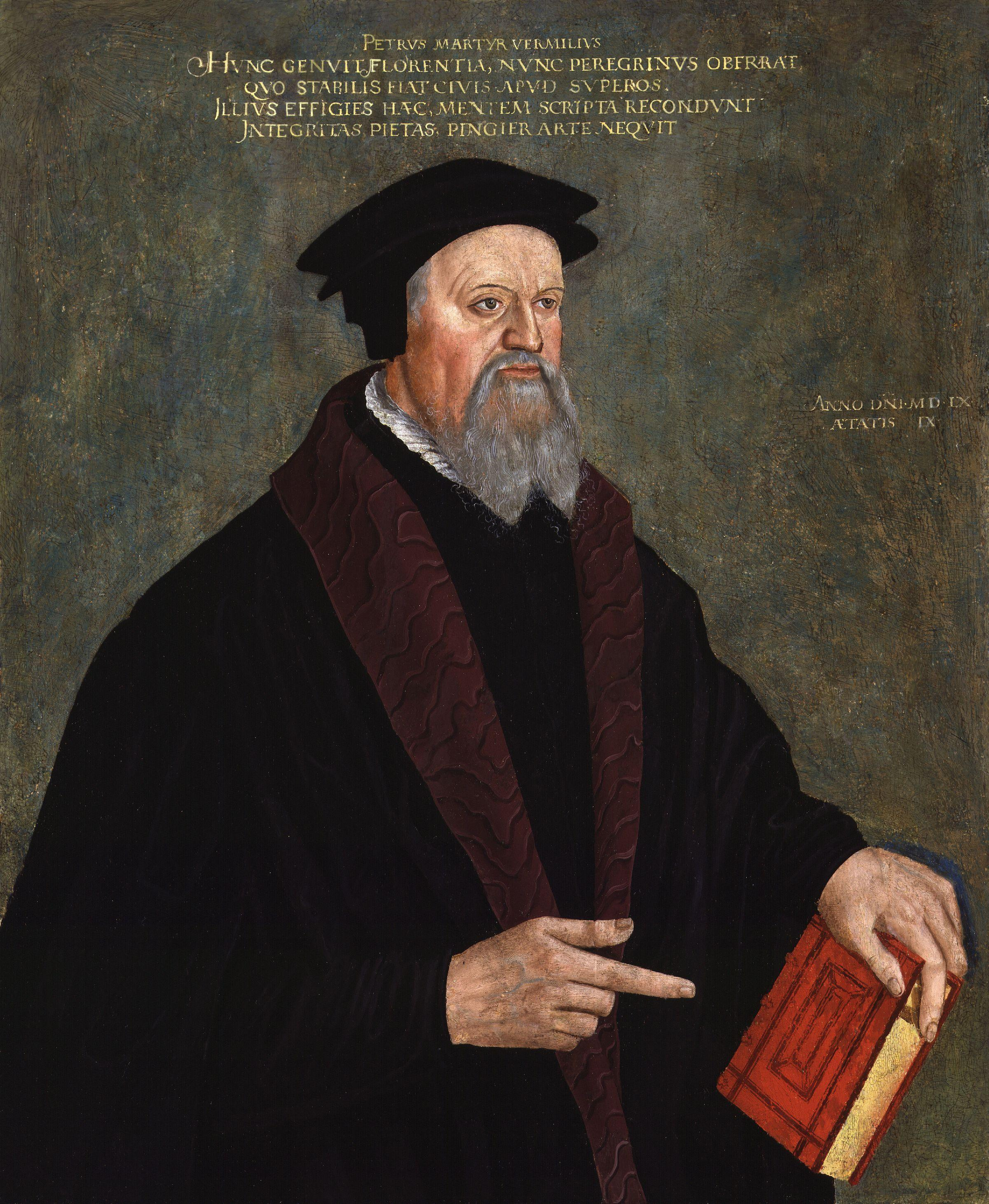
Peter Martyr Vermigli (1499-1562)

One of the stories told about the Reformation in missiological circles is that the reformers weren’t interested in seeing the gospel go to the ends of the earth. Those who make this claim propose a variety of reasons for the failure. Perhaps the Reformers’ horizons were limited to Christian Europe or they were too busy arguing amongst themselves about minute points of doctrine to worry about the millions perishing abroad. Maybe their exegetical method caused them to limit the Great Commission to the apostolic era. Or maybe something inherent in Reformation theology works at cross purposes with global evangelism.

Whatever the rationale alleged, one important source of the claim that Protestants were missionary failures is the founding father of academic missiology, Gustav Warneck (1834-1910), who took the Reformers to task. Warneck concluded that Luther’s “view of the missionary task of the church was essentially defective” and Calvin’s comments on the Great Commission (Mt. 28:18-20) had “not a word to say of a continuous missionary obligation of the church,” but instead used the text as a launching pad for an attack (yet another!) upon the papacy. Even in its second edition, Ruth Tucker’s popular biographical history of missions implicitly follows Warneck’s interpretation of the Reformation, and a recent missiology textbook claims that “the sixteenth-century Protestant Reformation did not produce any missionaries.”

Gustave Warneck (1834-1910)

To state the obvious, the theological vision of Protestants draws heavily upon the reformers. If Warneck is right that they didn’t have time for missions, will those of us who locate our confessional roots in the Reformation find that they don’t nourish and support an effort to take the gospel to the nations? 

Now, in their kinder moments, Warneck and his many followers concede that Luther, Calvin, and their fellows simply couldn’t do everything. They had their hands full with reforming the church and avoiding arrest and execution. To expect them also to have focused their limited energy on reaching the ends of the earth, which admittedly felt much further away in the sixteenth century than they do today, is presumptuous and a bit unfair. 

But as more and more scholars reexamine the data, the story of a Reformation that wholly ignored mission is being replaced by one in which the “Reformation as a whole was mission,” to borrow historian Scott Hendrix’s lapidary phrase.

By way of example, consider Peter Martyr Vermigli (1499-1562), for whom the notion that the Reformers didn’t care about the global spread of the gospel would have come as something of a surprise. In his earlier days, Vermigli was an influential theologian, preacher, and abbot in Roman Catholic Italy. He came to embrace Protestant theology in the 1530s and began a reformation in the northern Italian city of Lucca. In 1542, finding himself too well known, Vermigli evaded arrest and inquisitorial trial by fleeing to the relative safety of the Protestant north. He spent the rest of his life as a trailblazing Reformed theologian and churchman who profoundly impacted three regions of Protestant Europe: the Holy Roman Empire (from Strasbourg), the Swiss Confederacy (from Zurich), and the Kingdom of England (from Oxford).

One of Vermigli’s most popular works is his Sacred Prayers from the Psalms of David, which provide a unique window into his theological heart. They’re also a rich devotional supplement for anyone reading through the Psalms in part because they absolutely drip with a global vision for Christ’s kingdom and challenge us to locate our own Christian experience within the larger story of God using his people to build his church around the world. This emphasis is no surprise, for the Psalms have a power to shape the hearts and minds of those who read, pray, and sing them regularly.

Consider this gem drawn out of Psalm 47:

Good Father, grant that our sins may not impede your kingdom. Continue to conquer new people for the faith and make nations, which so far have been without the faith, obey your word. You have chosen for yourself the Church as a choice and special inheritance; may you be greatly glorified in her forever by exquisite melodies and hymns so that all people may possess you, praise you, and sing to you as their king.

Mission mindedness? Check. Global vision? Check. Unreached people groups? Check. But there’s something else here as well. Vermigli’s prayer flows out of his awareness of the church’s own sins and a request that they not undermine the advance of Christ’s kingdom. That’s a humble and self-effacing way to approach cross-cultural evangelism that doesn’t jibe with the stereotypical bad missionary who lugs along a sense of his own superiority while sojourning abroad.

Or consider the prayer for Psalm 67, a psalm that explicitly calls upon all peoples to praise God. Vermigli makes this petition:

Grant, good Father, that we may seek and obtain [the enjoyment of your gracious favor and the illumination of your face upon us]. Be not slow in adding to them a happy yield from the earth. The more generous you are to your dear people, the more you will be feared and the more earnestly honored throughout the whole world.

Did you catch what he did there? Vermigli follows the flow of the psalm in connecting God’s blessing of his people (Ps. 67:1) to the spread of godly fear and reverence among the nations (v. 2). Earlier in this same prayer, Vermigli notes that, as God’s people sin, they find themselves separated from those blessings but, as they repent, God in his mercy “scatters the dark clouds.” Those who sing this psalm are urged to rest content in his providential ordering of “all nations, provinces, and kingdoms,” even during hard times.

Now, it’s fair to say that Reformation-era Protestants weren’t strong on formulating concrete plans for mobilizing global evangelism. But we shouldn’t miss the fact that Vermigli’s prayerful meditations do emphasize the mechanism by which he expects the knowledge of the glory of the Lord to fill the earth as the waters cover the sea (Hab. 2:14). In his prayer for Psalm 67 and repeatedly elsewhere, Vermigli rehearses the same theme: the nations will worship the one true God when his people experience and bear witness to his blessings.

As this suggests, the church plays a central role for Vermigli in bringing the nations to Christ. He identifies the work of God in and for his church—forgiving, delivering, preserving, strengthening, and protecting her—as the lure that draws those outside the church into worship. 

In his prayer on Psalm 86, for example, Vermigli describes this type of divine care for the church as a “splendid banner” that, being seen by all people, will provoke general astonishment. As God strengthens and delivers his people by the power of his hand, then the nations will see and know, then the church’s witness to her own enemies and to other nations will be compelling.

Over and over in his prayers, these missional themes rise to the surface. Vermigli calls upon God to bring about the ever increasing proclamation of his goodness and inexhaustible kindness to all peoples (Ps. 93), the extolling of his name everywhere that all peoples might adore and reverence the divine majesty with pure worship (Ps. 96), the refreshing of the downtrodden so that God’s fairness and justice might shine forth as widely as possible to all people (Ps. 98), and on and on and on. 

If the ultimate goal of these prayers is God’s glory, then Vermigli often fixes the worship of that God in and through Jesus Christ by all nations as the penultimate goal. The expansion of Christ’s kingdom to the ends of the earth was emblematic of how God would get the glory.

Vermigli wasn’t really interested in most of what we now call “missions.” I doubt that he had any concrete plan in mind for reaching the ends of the earth. He wasn’t thinking about sending agencies or support raising or the complexities of cross-cultural ministry. In this, at least, Warneck is right: Vermigli’s energy was more focused on the lost who were just outside his door—the millions of people placing their hope in a false gospel—than on converting China or India.

But make no mistake, he earnestly prayed that the Lord of the harvest would bring reform to the church and end its suffering at the hand of its enemies so that the ends of the earth might hear the Gospel preached and turn to Christ in faith.

Most of the folks reading this will have theological roots that draw upon the Reformation, a gospel movement in which Vermigli played a profound (if nowadays largely forgotten) role. If his prayers are any indication, then we don’t need to set global evangelism aside to be good Protestants. But we probably do need to follow Vermigli’s lead by approaching that endeavor with a greater sense of humility, deep repentance, fulsome prayer, and recognition that God’s plan for Christ’s conquest of the nations is a ministry of the church. As we do, it wouldn’t hurt one bit for us to spend more time in the Psalter, being shaped and molded by the songs of that coming King.

Systematic Theology I: Covenant with Adam (Video 14)

Finally, we come to the end of this set of videos for the Systematic Theology I course. We end with a flourish, discussing the Adamic covenant of works established in Eden. This is a point of theology that has become increasingly compelling to me over the last few decades. What once seemed an interesting if speculative interpretation of the biblical data has been solidified as I’ve lived with the text.

If you want more on the topic, I commend Steve Baugh’s course Covenant & Kingdom, which is available in both audio and video for free.

Lessons Learned from Reading Calvin’s Institutes

It took nearly six months to make my way through the four books of John Calvin’s justly famous Institutes of the Christian Religion.1 Although I’d read substantial sections of it in seminary, I’d never tackled the whole thing from start to finish. 

Too often, I finish one book and move onto the next one without reflecting on what I’ve read. It’s a bad habit I’m trying to break. In the spirit of proper literary reflection, here are ten takeaways from my six months in the school of Geneva’s reformer.

1. Calvin had a vast knowledge of Scripture. Not only was Scripture the most important source in the Institutes, cited far more frequently than any other, but the range of his citations was astonishing. Scholars emphasize that Calvin often used the Institutes to address issues that didn’t really fit into his sermons or commentaries and that good readers of Calvin will want to interact with all three genres—Institutes, commentaries, and sermons—to get the full picture. No doubt this is correct but his familiarity with the Bible bleeds over from his exegetical efforts into his Institutes. Seeing such wide and deep exegetical knowledge brought to bear in a theological work of this scale is a marvel to behold.

2. Calvin was deeply engaged with church history. He understood that being a Christian meant being connected to all of the Christians who preceded him. He read (widely) among the Church Fathers and (not quite as widely) among the medievals as well as among the theologians of his own day. This engagement with the sources allowed him to bring the debates of the past into conversation with the controversies of the present and, by considering how the church and her theologians had previously engaged those issues, move his readers through confusion toward conclusion.

3. Calvin’s reading of Scripture and church history flowed out of his formation as a Renaissance thinker rather than an academic theologian. The way we’re formed intellectually determines our approach to many topics because pedagogical methods are not neutral. 

For Calvin, the result was that, having been formed in a different mould, he could engage Scripture and theological reflection in ways that were both different from and (often) superior to those trained in more traditional contexts in medieval universities. Most strikingly, Calvin read the Old and New Testaments in their original language with care to the meaning of the words in their biblical context. Herman Selderhuis comments, “This freed [Calvin], to a certain extent, from the intrinsic and formal ballast that the average theologian received from the study of scholastic handbooks.”2

4. There’s not a lot of Calvin the man in here. It’s difficult to recall any personal anecdotes that grace the pages of the Institutes. Some theologians don’t hesitate to insert themselves into their writing, but Calvin, who famously sought a life of reclusive scholarship only to find himself called into a life of public service to the church, avoids the limelight. In fact, he’s hardly even in the shadows. This is all the more remarkable given that the Institutes have a strong authorial voice. Although Calvin frequently addresses the reader and his adversaries, he very much operates in a ministerial capacity, in service to God and his church.

5. The Institutes are a big book. Really big. To be sure, that adjective applies to impact, influence, and importance, but for the moment I primarily want emphasize simply that the Institutes are extremely long. English translations of the “definitive” 1559 edition (as opposed to the rather briefer earlier editions of 1536, 1539, 1543, 1550) vary from about 1,300 to over 1,600 pages, and we’re not talking about large print editions. Nor does Calvin coddle his readers. There’s little fluff here; each paragraph is dense. 

It’s genuinely hard to imagine the acuity of the mind that could think all of these thoughts, set them out succinctly and clearly, and expect others to receive them. To profit from a reading of this behemoth requires focus, and even then…. As I turned the corner into Book Four it dawned on me that I was only now, perhaps, ready to read the Institutes for the first time.

6. Despite its size—indeed, because of its size—the work is tightly organized. The whole thing holds together in a remarkably coherent fashion. Calvin clearly knows where he’s going and when he plans to address each issue. Anyone who has ever written a long article, essay, or report—let alone worked on a book-length project—will know how challenging it is to keep everything in its proper place, avoiding repetition or failing to introduce a concept at its first appearance. Calvin does this majestically on a grand scale as well as anyone I’ve ever read.

7. The Institutes were not composed as a systematic theology intended to cover every locus in a logically organized way or to show how every topic is connected to every other topic. It’s a much more dialogical work than, say, Mastricht, Hodge, or Berkhof. Calvin leaned heavily on the Apostles’ Creed as the frame upon which he built. Hence, the entire work is divided into four “books,” following the Creed, devoted to the God the Father, God the Son, God the Spirit, and the church. 

King Francis I of France (r. 1515-1547)

Now, it wouldn’t be altogether wrong to describe the Institutes as a systematic theology but if we do so, we should keep in mind a couple of goals that Calvin had for the work, which distinguish it from most recent systematic theologies. First, Calvin wrote the Institutes so that pastors and future pastors would have, in a single accessible book, the doctrinal knowledge that they’d need for their labors in the trenches as ministers. In other words, it wasn’t an academic work written primarily for professional theologians or scholars. Second, as is clear from the very outset in the dedicatory letter to King Francis I of France (no friend to the Reformed churches), the Institutes were meant to function as an apologetic for biblical Christianity, a polemic against false teaching, and an elenctic (that is, an effort to persuade) for those who disagreed.

8. This work has been profoundly influential. Proof of this is that so much of what he says now seems obvious. Calvin, however, was the first Protestant author to produce an overview of Christian belief that was so exegetically grounded, so vast in scope, and so internally coherent. If you read the Institutes and find yourself thinking, “What’s the big deal? Isn’t that just what Christians believe?” then you’re testifying not to the fact that Calvin is derivative but rather that he was a master at making plain what Scripture teaches.

The “Viceroy” Tulip (1637)

9. The Institutes are not primarily about the doctrine of predestination. Those who have been reared to understand that “Calvinism” is tantamount to the TULIP acroymn will find themselves sorely disappointed. It’s not that Calvin doesn’t teach predestination or even that the doctrines of grace aren’t important to his theological system. They are. But they constitute one small piece of a much larger project that aims at a much larger goal than convincing readers that divine election preceded the creation.

10. We come a lot closer to grasping the heart of the Institutes if we understand that Calvin’s purpose for the work was to strengthen his readers in Christian piety and devotion. That may seem an odd claim for a work that contained so much heady and precise doctrine. But Calvin believed that the better God’s people understood the Scriptures, the more they would love their Savior. In Calvin’s vision of the Christian life, doctrine and piety were not opposed to one another. In this, as in so much else, Calvin and his Institutes are faithful guides for the church. 


1 I read from Henry Beveridge’s  translation of the 1559 Latin edition of the Institutes originally published by the Calvin Translation Society in 1845.

2 Herman J. Selderhuis, The Calvin Handbook (Grand Rapids, MI: Eerdmans, 2009), 200.

Systematic Theology I: The Image of God (Video 13)

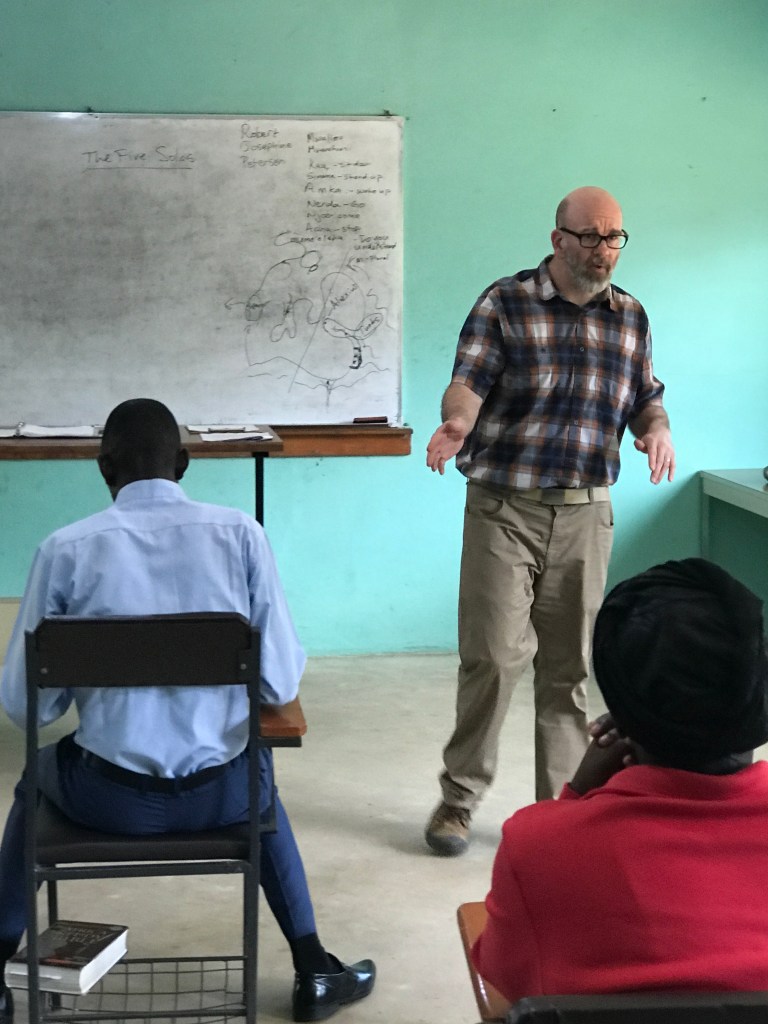
We’re closing in on the end of this series of lectures from the Systematic Theology I course that I taught in S. Asia. It would have been most natural for my portion of the ST sequence to come to an end with the doctrine of God (or Theology Proper, as it’s called), but because of the amount of material that needed to be covered in the 2nd and 3rd parts of the sequence, I agreed to handle part of the doctrine of man (aka, theological anthropology) as well.

This means that we handled the image of God and the covenant with Adam at the end of this course. Both of these topics connect well with what comes before, so I was happy to include them.

Video 13 addresses the former topic, the divine image. It’s a rather more complicated and, in some regards, controversial topic than I had anticipated when I began thinking about how to teach it. Although I do point out some obvious dead ends, by and large, the video presents the various options without coming down too hard on a specific conclusion about what precisely the image of God in mankind is. At least as I’m thinking about this topic at present, there’s sufficient room within the scope of this doctrine to allow for various ways of describing how the image is constituted.