Reading CCR: Prove it (§I.ii).


God speaks in the writings of the prophets and apostles.

Although God has made himself and his eternal power and deity known—neither meagerly nor obscurely—to men of all the earth by means of those things which he has made, so that everyone who does not glorify God might be without excuse, nevertheless, we know that God has revealed His will clearly and fully in a special way, namely, by means of Spirit-inspired prophets and apostles, and by means of their writings. And, therefore, the prophetic and apostolic writings are the very word of God.[1]

Jerome Zanchi, Confession of Christian Religion, §I.ii

Zanchi continues confessing a doctrine of revelation by making a basic scholastic distinction between general and special revelation. By means of the former, God has “made himself… known” to all people in all places at all times. “How,” you ask, “has he done that?” Zanchi doesn’t elaborate on the matter here (I imagine because it would have been so obvious both to him and to his readers), but the brief answer is: in his work of creation (“those things he has made [facta sunt]”). The world around us (including ourselves—body and soul) testify to “his eternal power and deity.”
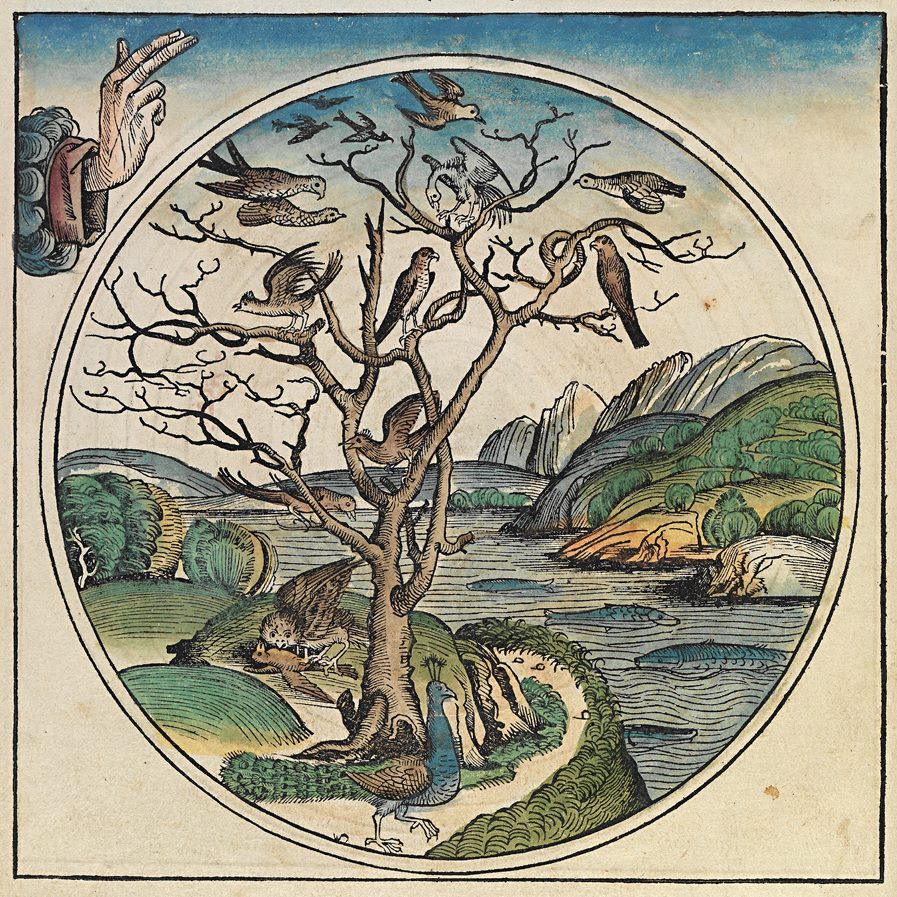
Michael Wolgemut’s woodcut of Day Five of Creation from the The Nuremberg Chronicles (1493)

This isn’t a proof for God’s existence. At least, not in the way that we usually think about that sort of thing. Zanchi isn’t trying to use the witness of creation to convince his readers that God exists. His point is more that the witness is there, whether we accept it or not. God has made himself known to all people, so no one has an excuse. No one can say to him, “But I didn’t know that I was supposed to glorify you!”

Yet, notice that what we can know on the basis of that general revelation is limited: his eternal power and deity. Now that’s a lot. We could do a fair amount of a course on the doctrine of God based just on those few words (drawn from Rom. 1). But it turns out that there’s more that we must say (because there’s more that has been revealed).

God doesn’t only reveal himself to us through creation. He also speaks in a “special way” to and through human beings who are inspired by the Holy Spirit. God’s revelation of himself to these apostles and prophets was both more limited and also much fuller than general revelation.

It was more limited in the sense that this revelation wasn’t equally and always available to all people. It came at specific moments in history to specific individuals who lived in specific places. So, someone living in Denmark in the 10th century BC didn’t get to hear David singing a psalm newly composed as the Spirit carried David along (2 Pt. 1:21). As Ps. 133 envisions it, God’s blessing of eternal life comes specifically (of all places!) by way of Jerusalem.

Although Zanchi doesn’t “go there” in this passage, the great example of this narrow specificity is the fact that God’s Son became incarnate for us and for our salvation by taking upon himself a human nature, including a normal human body and a rational soul (with all of their limitations), and living a relatively short life in a relatively confined geographical area.

If this special revelation was more limited in its publication, it was nevertheless much richer than general revelation in the information disclosed. Later, Zanchi will give us entire chapters devoted to what constitutes the Law and the Gospel (which for him encompasses everything in Scripture), but he doesn’t wade into those waters here. Instead, his point is just that special revelation come to individual prophets and apostles and is then written down in such a way that those writings are “the very word of God.”

Sitting more than 400 years to Zanchi’s right on a timeline and having experienced the unsettling effects of the Enlightenment (not to mention textual criticism, theological liberalism, moral therapeutic deism, etc.), our response to §I.ii is almost certainly going to be something like: But how do you know that these are the very words of God?! What’s the demonstrable proof?

In the following paragraph (§I.iii), he does offer a sort of rationale (as we’ll see), but it doesn’t answer those questions in the way that we want it to. When we expect Zanchi to slam on the theological breaks, he surprises us by pumping the gas pedal. So, I wonder if we’re asking the wrong question or asking the right question in the wrong way. (Or maybe both.)

Caravaggio, Conversion on the Way to Damascus (c. 1600)

Zanchi’s bracing approach to Scripture here reminds me that we shouldn’t start from a posture of hubristic pseudo-sovereignty when we lift our eyes up to God. Before we come to Scripture, the world around us has already revealed that we’re creatures who exist in relation to and on account of an eternally powerful and divine Creator. So, as we turn our minds toward the Source of our existence, maybe the first thing out of our mouths shouldn’t be a huffy challenge: “Prove to me that you exist and that the Bible is the very word of God and then, once I’m fully convinced, I’ll recognize you as God.” Maybe we begin instead with humility.


[1] Margin: Rom. 1:19-20; Heb. 1:1; Heb. 2:3; 1 Pt. 1:21; Mat. 10:20.

Pastoral Training for Geneva’s Exiles

Note: This article is the last of four about the historical background of diaspora ministry. It first appeared on the TLI website. (See the first, second, and third parts.)

In a series of short articles, I’ve been placing “diaspora ministry” into a broader historical context to emphasize that the church has always viewed it as a way of engaging the Great Commission. I’ve shown how pivotal moments in the history of missions led to a focus on ministering to sojourners who then carried the gospel message forward, often to unreached peoples. It turns out that the apostolic church naturally reacted to Christ’s promises and commands in Matthew 28:18–20 by doing diaspora ministry and that modern missions movement not infrequently developed—both at home and abroad—into ministry focused on diaspora communities, whether Koreans living in China or Japanese living in California.

This final article takes us to sixteenth-century Geneva, where pastoral training and diaspora ministry intersected. Centers of Protestantism like Geneva became launching pads from which the gospel, recovered during the Reformation, went forth to Europe and beyond. In large part, they did so by ministering to exiles and refugees, especially by training them for gospel ministry.

The French Exile

John Calvin knew well what it meant to be a refugee, having fled France in 1534 for political, legal, and religious reasons. He hoped for a life of bookish solitude. Instead, he found himself pressed into service as a reformer in Geneva, only to be dismissed and exiled when the city fathers decided they didn’t like how ille Gallus (“that Frenchman,” as council records dismissively identified him) planned to implement reform. There followed a sojourn in Strasburg, where a patient Martin Bucer molded the brilliant (if tightly wound) young theologian into a pastor.

Geneva soon asked Calvin to finish what he’d started, and he accepted. But until 1559, just a few years before his death, he wasn’t a citizen, merely a sojourner praying for a Protestant France. He had no formal political power and couldn’t even vote in civil elections.

Among the many legacies of this “buttoned-up French exile” was his ministry to refugees who arrived in Geneva. He advocated for the displaced, and his Geneva became a bustling hub of hospitality. This was the context within which Reformed Protestantism—in and around Geneva, across Europe, and even further afield—became the most dynamic Reformation movement of the age.

Theological Training for Outsiders

Beginning in the 1530s, waves of French exiles in Geneva mingled with English, Scots, Spaniards, Italians, Dutch, Hungarians, and Poles. Some stopped only briefly; others put down roots. In an age when urban planning and social welfare programs were mostly unknown, Geneva roughly doubled in size to accommodate the influx of huddled, traumatized masses. Some families could support themselves, but others carried only the clothes on their backs, the knowledge in their heads, and the skills in their hands.

Then as now, the arrival of immigrants sparked debate and tension, and Calvin’s support for the refugees cost him politically. But the creation of the French Purse, a privately endowed charitable fund, helped Geneva care for so many without undermining the town’s financial stability. So the refugees came, and they were welcomed.

Some stayed only briefly, like John Knox (c. 1514–72), the Scot who remembered Geneva as the “most perfect school of Christ since the disciples,” or Girolamo Zanchi (1516–90), who had fled Italy with the Inquisition on his heels. Others stayed put. Italian converts to Protestantism like the Diodatis, Turrettinis, Colandrinis, Burlamachis, and dozens of other families found a home in Geneva and joined its Italian-speaking congregation. They built businesses and produced some of the most celebrated pastors and theologians in the town’s history. Giovanni Diodati served both as a pastor and a professor at the Genevan Academy for nearly fifty years and made the first Italian translation of the Bible from the original languages. Benedetto Turrettini (1588–1631) and his son François (1623–87) became professors of theology and churchmen. The son, who’s better known to Anglophone audiences as Francis Turretin, wrote a richly influential theological textbook that remained the gold standard in Reformed circles for two centuries.

This points the way to a striking conclusion: Calvin (and Geneva) didn’t merely care for the refugees’ physical needs. They committed significant resources specifically and strategically to the pastoral and theological training of outsiders. To the Diodatis and Turrettinis add the examples of Thomas Bodley (the Marian exile who founded the renowned Library at Oxford) and Caspar Olevian (co-author of the Heidelberg Catechism) along with hundreds and hundreds of other non-citizens who studied at the Genevan Academy after its founding in 1559. Alumni from the refugee community supplied pastors not only for churches back in France—more than 220 between just 1555 and 1562—but also for those in and around Geneva. Parishes in Geneva’s hinterlands were staffed, to a man, by diaspora pastors until 1570, and, within the city itself, until 1594.

Calvin (and Geneva) didn’t merely care for the refugees’ physical needs. They committed significant resources specifically and strategically to the pastoral and theological training of outsiders.

Mentoring Diaspora Ministers

The work of discipleship and teaching didn’t end once sojourners departed. Calvin and other professors and pastors continued to correspond with those who left to serve abroad, offering encouragement, admonition, and advice. Calvin’s letters to Girolamo Zanchi, for example, helped the Italian navigate a protracted controversy into which he stumbled while teaching at Strasburg.

Face-to-face mentoring and letter writing were supplemented by the printed word. His formal writings often incorporated the goal of serving those who had sojourned in Geneva before returning home or moving on to minister elsewhere. Take the case of the young Frenchman François Daniel. He came to Geneva to attend the Academy against his parents’ wishes. Daniel’s father wanted him to study law, but the son was drawn toward the pastorate. Calvin mediated and, eventually, the boy returned home, but the reformer continued to advocate for and correspond with him. In 1561, Daniel wrote from Orleans asking for resources to continue his theological education, and Calvin obliged by sending a copy of his Institutes of the Christian Religion—virtually a one-volume seminary education. The young man went on to serve the French Reformed congregation of La Rochelle as a pastor for decades.

Calvin’s Geneva was hardly unique. Reformation cities like Strasburg, London, Emden, Neuchâtel, Antwerp, Zurich, Basel, Lausanne, and others, similarly and regularly extended hospitality to refugees. Reformed centers for the training of gospel ministers shaped diaspora pastors from all over Europe, and often it was diaspora professors who did the training—the Spanish Cypriano de Valera (at Cambridge), the Italian Peter Martyr Vermigli (at Oxford and Zurich), the German Martin Bucer (at Strasburg and Cambridge), and the French Franciscus Junius (at Heidelberg and Leiden), among many others.

Global Immigration and Gospel Opportunities

Diaspora ministry, or the training of refugee pastors, wasn’t done perfectly in Geneva (or, for that matter, anywhere else). Especially in the early years, alumni of the Academy found that there were significant gaps in their education. Hospitality could be restricted to those who saw eye-to-eye with Calvin. Some, like the Spanish Casiodora de Reina, finding that he couldn’t toe the reformer’s line, soon moved onto more accommodating environs. Others, like the anti-Trinitarian Michael Servetus, who was burned at the stake, stuck around too long.

Yet we should be encouraged to discover that, despite many imperfections, Reformation Europe owned the responsibility to sacrificially commit resources over the long term for the love of neighbors in need. But there’s another important takeaway here. Calvin and others saw the influx of outsiders as an opportunity for advancing the gospel through the training of future ministers. The goal was to spread the gospel in Europe and beyond; the members of refugee communities who sheltered in Geneva, studied at the Academy, corresponded with Calvin, and drew from his writings put their shoulders to the plow and did much of that work.

This series of articles began by noting that, as of 2017, more than a quarter of a billion people worldwide were living outside their country of origin. The same responsibility that the Genevan church bore—to love neighbors in need for Christ’s sake—confronts Christ’s Church today. Many exiles and refugees live abroad, not willingly, but on account of their confession that Christ is Lord. Our responsibility toward those who “are of the household of faith” is clear (Galatians 6:10). But describing this as an obligation to fulfill or a responsibility to bear doesn’t actually capture its weightiness. The pregnant reality is that diaspora ministry has been a mainstay in the faithful declaration of God’s name among the nations. 

Diaspora ministry has been a mainstay in the faithful declaration of God’s name among the nations.

By ministering to diaspora communities in our midst, we minister to those abroad as well. As Earnest Sturge put it, “The work is one.” That work, especially raising up gospel ministers to proclaim the unsearchable riches of Christ (Ephesians 3:8) to their communities at home and abroad, is Great Commission work. It will bear fruit, for Christ will always be with his church, to the end of the age (Matthew 28:20).

Reading CCR: Laying a Double Foundation (§I.i)

We recently had a new driveway poured at our house. Of course, this meant getting rid of the old one first, which we assumed would be a bit of a task. As it happened, however, a mini-forklift made short work of it, leveraging great chunks of cement out of their resting places and, in a matter of minutes, piling them up to be disposed of. 

God forbid we ever have to pull up the new driveway,but if we do, it won’t be nearly as easy. This time, the workers laid down steel rebar before they poured to reinforce the concrete and increase its tensile strength. It’s not going anywhere without stiff resistance.

As in driveways, so in theology, not all foundations are equal.

Zanchi begins the first chapter of his Confession of the Christian Religion (CCR) by addressing revelation, which he calls “the foundation (fundamentum) of the whole Christian religion.”

Five-hundred pages of theology is a heavy load—both physically and metaphorically!—so, how did Zanchi lay the foundation for it in such a way that the project didn’t collapse under its own weight? The answer is, he started with Scripture… and with God.

It was standard fare for Reformed confessions to begin with Scripture, so it’s no surprise to see Zanchi follow suit. He calls it “the foundation (fundamentum) of the whole Christian religion.” But there’s more going on here than a naive biblicism or what some have labeled solo Scriptura (Scripture only; in contrast to the Reformation position of sola Scriptura, Scripture alone).

When we actually look at how Zanchi enters into this topic, we see that he doesn’t just run in and tag the Bible or even revelation more broadly. Instead, he begins with the foundation that lies beneath the foundation of all revelation. Here’s what he says:

With regard to God and the divine matters that pertain to Christ’s kingdom and our salvation, we believe that no one can teach us better or with more certainty than God Himself, who can neither be deceived nor deceive. “No one has ever seen God; the Son, who is in the Father’s bosom, He has expounded Him to us (Jn. 1:18).”

Jerome Zanchi, Confession of the Christian Religion, §I.i

In other words, Zanchi begins his discussion of revelation by talking about God, who is the source of revelation. This makes all kinds of sense. In order for us to say anything about God, we have to have (true and intelligible) revelation—whether general revelation (in nature, for example) or special revelation (in visions, dreams, writing)—that tells us something about the God making himself known. Otherwise, at best, we’re just guessing or, more likely, making stuff up.

This is why Reformed scholastic theologians (like Zanchi) often talked about Scripture as the principium cognescendi theologiae externum, the external cognitive foundation of theology, which reveals the principium essendi theologiae, the essential foundation of theology (that is, God). I’ll quote Richard Muller here:

Without [Scripture], theology could not know the truth of God—without [God], there could be no theology, indeed, no revelation.

Post-Reformation Reformed Dogmatics, 2:151

In special revelation, it’s God himself who does the revealing. And we can trust his revelation because, being who he is, God never gets mixed up or hoodwinked and he never lies or obfuscates. He reveals the truth precisely as he intends to. Following the lead of Ambrose, the 4th century bishop of Milan, Zanchi emphasizes that no one communicates better than God, because he maintains complete control over the flow of information.

So, divine revelation is a foundation of knowledge built upon this essential bedrock: It is God who reveals himself. So far, so good. But Zanchi has one more big move left to make. The purpose of revelation isn’t primarily to teach biology (how does a dorsal fin work?) or sports trivia (who won the Series in 1919?) Rather, the special subject of revelation is “things pertaining to religion” (as the paragraph’s heading puts it).

But, when it comes right down to it, even that is too broad, because “things pertaining to religion” doesn’t actually address the glaring problems that stand before us: a broken world and sinful hearts. It’s not enough that everything points to God generally. What we really need to hear about is “Christ’s kingdom and our salvation.” Does God have any good news for us sinners and sufferers (as Dane Ortlund recently put it)? 

Zanchi’s response is, “Yes, he does,” which may not be a big surprise but is a big deal. It turns out that God doesn’t reveal himself to us so that we can learn theological trivia, as if what our hearts really craved was abstruse metaphysical speculation about who God really is. As if the thing that kept us awake at night was whether (to be really silly about the whole thing) God was blue or green. Who cares?

Scripture doesn’t answer those sorts of questions because that’s not what it’s for. Instead, it provides critical answers to life and death questions, need-to-know information. This is why Zanchi naturally turns our minds to the first chapter of John’s Gospel. The Son, who alone knows his Father fully, is the great Revealer. He made his Father known not by shouting down from heaven but by becoming incarnate for us and for our salvation. The divine Word became flesh (Jn. 1:1, 14) in order to proclaim and accomplish God’s saving work on behalf of his people. Divine words and divine works go hand in hand and are aligned in purpose.

Zanchi begins his confession with a dual commitment to the revelation of the self-revealing God and to the God who self-reveals. It’s the sturdy double foundation upon which everything else gets built precisely because we—each one of us—can only have eternal life if we know the God who supplies it and who made himself known to us in his Son (Jn. 17:3).

The Diasporic Roots of Korean Christianity

Note: This article is the third in a four-part series that I wrote exploring the historic roots of ministry to and among diaspora communities. This one appeared first on the Gospel Coalition. (See also part one and part two.)


The traditional narrative explaining the rise of Asian Christianity in the modern age is a story of Western goers sent by Western senders, and there’s some truth to that. The Opium Wars of the 1830s, 1840s, and 1850s served as a catalyst for opening China. Waves of missionaries followed, most famously J. Hudson Taylor (1832–1905), whose China Inland Mission made significant inroads.

But the story turns out to be more complicated.

Beginnings of Korean Christianity

Admittedly, the Protestant West viewed China as the ripe plum of East Asia, but it wasn’t the only missionary target. Take Korea, for example. Nicknamed the “Hermit Kingdom” by one Western observer in 1882, Korea closed its doors to foreigners and showed hostility toward Christianity. But from the 1860s, instability and oppression at home spurred a diaspora movement that drove individuals out of the peninsula. Some found their way across the Chinese border to Manchuria, where they fell in with Chinese Christians and Western missionaries unable to cross into Korea.

Seo Sang-ryun

One such figure who entered Manchuria at this time was the businessman and merchant Seo Sang-ryun (1848–1926), who had been running ginseng from Korea. On one trip across the border he fell deathly ill. Two Scottish Presbyterians—brothers-in-law John Ross and John MacIntyre—nursed him back to health. He became a Christian and was baptized. Seo’s return to Korea a few years later proved a pivotal event in church history and should upend how we in the West remember the role of missions in the globalization of the faith.

The Modern Missions Movement and Korea

To understand why, we have to go back nearly a century to the publication of William Carey’s An Enquiry into the Obligations of Christians to use Means for the Conversion of the Heathens (1792), which substantially shaped how Western Christians thought and still think about missions. By “means” Carey meant forming missions societies, what Paul Pierson calls “a structured committed community of men (and eventually women) who knew that their call was to take the Gospel to other areas of the world.” This innovation allowed resources to be coordinated cross-confessionally—not only the human resources of those who went abroad to take the gospel to the ends of the earth but also of those who stayed home and supported the mission financially, relationally, and prayerfully.

The response was striking. Networks and societies of stayers and goers formed, propelling Christianity—admittedly, Christianity sung in a Western key—around the globe. The financial capacity, geographical extension, and political weight of the British Empire were pressed into service. Other Western nations followed suit, often marrying political expediency with religious fervor as the gospel advanced in colonial holdings.

This story, or something like it, undergirds how we remember the substantial progress of Christian globalization over the last two centuries. But this model of (Western) senders and (Western) goers doesn’t account for its own success. Then, as now, the evangelization of unreached peoples often hinges on the presence of a diaspora community in a context where the church already exists rather than on the insertion of foreign missionaries into an unreached culture. We can see this in the story of Seo Sang-ryun and the origins of Korean Protestantism.

The evangelization of unreached peoples often hinges on the presence of a diaspora community in a context where the church already exists rather than on the insertion of foreign missionaries into an unreached culture.

The Bible in Korea

It turns out that John Ross, one of the Presbyterians who baptized Seo, had been seeking opportunities to reach Korea for Christ since the early 1870s, but he couldn’t get in. The Korean government prohibited even teaching the language to foreigners. Nevertheless, from his base in Mukden (now Shenyang), Ross found a tutor. He focused on learning Korean, translating texts into, and ministering to the diaspora in Manchuria. His labors began to bear fruit.

John Ross (1842-1915)

Converts began to worship alongside Chinese Christians and smuggled contraband literature across the border. From the late 1870s, a small group of Koreans that included Seo partnered with Ross and MacIntyre to translate the Bible. In 1882 they completed the Gospel of Luke, the other three Gospels in 1884, and the entire New Testament in 1887. Significantly, they didn’t translate into the language of the educated elite but into the Hangul vernacular.

When he returned to Mukden, the peddler who first carried the copies of the Gospels (along with his own testimony of faith in Christ) to the Korean diaspora of eastern Manchuria reported that many now wanted baptism. In winter of 1884, Ross traveled there, baptized 75, and put other names on a list for his next visit.

Seo Sang-ryun’s Ministry and Work

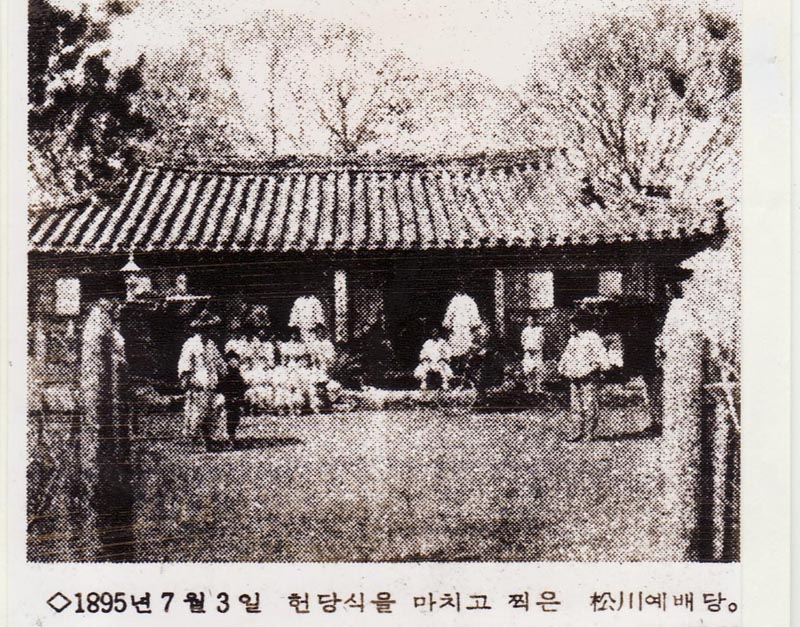
Seo returned to Korea in that same year. He labored as an evangelist and organized prayer meetings, initially at Ŭiju (his ancestral home), just over the Manchurian border on the Yalu River. But after taking heat for his foreign contacts, he established a more permanent ministry at Sorae, a remote fishing village over the mountains from Changyon in Hwanghae Province, where his extended family lived. It was in Sorae where Seo Sang-ryun and his brother Seo Sang-u established what is now regarded as “the best supported claimant to be the first Korean church.” They met secretly for worship behind locked doors.

The Church in Sorae (ca. 1895)

But was it really a church? Reformed theologians often describe a true church as characterized by the preaching of God’s Word, the administration of the sacraments, and the exercise of church discipline. By all accounts, the first of these was present. But as an unordained evangelist, Seo never asserted authority to baptize or administer the Lord’s Supper. Nor did he formalize church membership. He was apparently content to wait until his flock could be formally incorporated into the visible church of Christ.

In practice, this meant waiting for a Western missionary, and from before 1885, the congregation in Sorae repeatedly asked Ross to come. After signing a series of “unequal treaties” with foreign nations, Korea slowly opened its doors, but missionary work remained prohibited, and Ross was not free to come. Instead, he introduced Seo by letter to the American Horace G. Underwood (1859–1916), another Presbyterian, who had recently arrived in Seoul and was quietly engaged in medical missions, education, and orphan-care as he learned the language. Seo met Underwood in late 1886. 

Although evangelism of Koreans was illegal and conversion a capital crime, Underwood received a small delegation of Christians from Sorae the following spring. He recorded, “They were examined before the whole Mission, and finding they had been believers for some years, and were able to state intelligently the ground of their faith, the Mission unanimously decided three of them should be admitted to the Church by baptism.” (Some, perhaps all, of the remaining members of the delegation had already been baptized.)

In the fall of 1887, Underwood’s mission felt bold enough to attempt an itinerant preaching tour—from Seoul to Sorae, Pyongyang, and Ŭiju. Another seven were baptized in Sorae, where believers continued to meet regularly for worship under Seo’s pastoral care.

In September of that same year, perhaps just before Underwood itinerated, Ross finally visited Korea. He met with Underwood in Seoul, where he witnessed the founding of the Saemoonan Presbyterian Church, the first church in Korea pastored by an ordained minister. Its membership was comprised of 14 Koreans—13 were from Sorae. A week later, two Korean elders were ordained, and the following year the first four Korean women were baptized. Within a decade, Saemoonan had planted several daughter churches, and the growth continued.

John Ross wanted to take the gospel to Korea himself but wasn’t given the privilege. Instead, he spent a decade among the members of the Korean diaspora in Manchuria. God, in his providence, used Seo Sang-ryun and other members of the diaspora community to lay the foundation for ongoing gospel ministry in their homeland (Romans 15:20; 1 Corinthians 3:10).

Fruitfulness of Diaspora Ministry

In Kenneth Scott Latourette’s magisterial History of the Expansion of Christianity (1937), he committed three of seven volumes to the century that followed the publication of Carey’s Enquiry. It was principally a story of Western missionaries bearing the gospel to the nations.

But that’s not exactly how it happened. Instead, missionaries were often received in new lands by native believers who had met Christ or grown in their faith while living elsewhere. During that “great century,” as Latourette dubbed the 19th, ministering to diaspora communities turns out to have been a fruitful way of fulfilling the Great Commission. It still is.

The village of Sorae is now part of North Korea, where Christians once again gather in secret and behind locked doors. But that’s hardly the last word. The Korean church has become one of the most active forces for cross-cultural evangelization in the world, with around 30,000 missionaries in the field. Ironically, when Western missionaries were expelled from China in the 1940s and 1950s, Korean believers became witnesses to their much larger neighbor. What seemed to be a footnote on the expansion of Protestantism in Asia turned out to be a major plotline in the story of global Christianity.

Systematic Theology I: Names and Attributes (Video 7)

Having made our way through the challenging waters of the doctrine of the Trinity (at least for now!), we’re moving onto talk about the divine names and attributes. As I reflected on this topic, I was pleased to find my thinking come more and more into line with the Great Tradition of Christian thought, which has concluded that the distinction between God’s names, titles, and attributes is less stark than we might initially suppose.

Ask yourself, when the Psalm 89 calls God “my Father, my God, and the rock of my salvation,” is “rock” a divine name or a divine title? Or is it a metaphor indicating a divine attribute?

An even more significant idea here is that God’s attributes are identical with his essence. This turns out to be very, very important. If we forget it, we wind up believing (among other unhelpful things) that there are competing agendas within God and no rest for our weary souls. Thankfully, God is most simple.

Reading CCR: Clearing the Throat

Before speaking in public, you always want to clear your throat, so that you can breathe easier, project further, and speak more clearly.

In the spirit of throat clearing, this post is meant to introduce “Reading CCF.” The idea is this: I’ve been working for some months on a translation of Jerome Zanchi‘s De religione Christiana fides (usually translated as Confession of the Christian Religion [CCR]), which was first published in 1585. I’m enjoying myself tremendously.

One of my motivations for doing this translation (in fact, I might even call it a conviction) is that I want to see the riches of classical Reformed theology made accessible to as many people as possible. Unfortunately, I’m a slow translator and this is going to take a while, so I thought it would be useful (to borrow one of Zanchi’s favorite terms) to post some of what I find as I go.

I’ll share more about the (fascinating!) history of the CCR some other time, but for now just a couple words about what it is. Short answer: a formal confession of faith written in the last third of the 16th century by one of the great Reformed scholastic theologian at the height of his powers.

Because it’s a confession, it’s meant to contain an entire system of doctrine, but it’s not a textbook of systematic theology. It’s less a tool for teaching than a statement of belief. He didn’t say everything that he could have said. Rather, Zanchi addressed critical topics that the church had faced in the past and was facing in his day so that everyone—friend and foe—would know where the confessors of this confession stood.

Now, unlike the Belgic Confession, Second Helvetic Confession, or the Westminster Confession of Faith, no church or group of churches formally subscribed to Zanchi’s confession. In that sense it was merely “personal” (or better “familial,” since he wrote it on behalf of his whole family), but it was also intended to be catholic (little “c”) in the sense that his aim was to confess what the universal (“catholic”) church confesses.

The Eighth Tome of Zanchi’s Opera omnia (1619)

The CCR is pretty long for a confession, coming in at over 500 pages of Latin text. (Although, just to give you some sense of Zanchi’s productivity, it only comprises about 65 dense double-column folio pages in the eighth “tome” of his collected works. That tome alone is about 850 folio pages in length.)

CCR begins with a long dedication to Zanchi’s friend, Ulisse Martinengo, followed by a somewhat shorter one “to the reader.” It then proceeds along what we would think of as a pretty typical ordering of the heads of doctrine, beginning with Scripture and ending with a chapter on eternal life. He divides the work into thirty chapters, which are further divided into numbered subsections that address specific issues and topics within that head of doctrine. At the end of the book, he has included several appendices (his “observations,” an “appendix” proper, and a series of “theses”).

Consider the throat cleared.

Systematic Theology I: Trinitarian Language (Video 6)

Another video on the Trinity from the Systematic Theology I course that I recently taught remotely. The primary goal here is to unpack some of the technical language that theologians use to discuss the doctrine of the Trinity: opposed relations, the filioque, inseparable operations, divine appropriations and missions, perichoresis, taxis, eternal generation, and so on. Heady stuff.

One good way to get your mind thinking in the right direction about this stuff is to begin by meditating on the question: “How do we distinguish the Father, Son, and Holy Spirit from one another?” The answer is what theologians call eternal relations of origin. You see, as soon as we start thinking about the Father, we are already thinking about the Son because they are in an eternal relationship with one another. In other words, to be Father, he must have the Son.

This is challenging material—we’re talking about things that are very close to the heart of the infinite God, after all—but I hope that as you think on these things you’ll come to know the Lord better and to love him more.

Cyprian and the Coronavirus

Note: This article was originally written in March 2020 (at the beginning of the pandemic) and appeared on the TLI website. I debated whether or not to post it here a year after the fact, but there’s nothing in it that I disagree with fundamentally even now.

I was talking with a friend who’s a financial advisor a few days ago. The Dow was down more than 2,000 points—spread of the Coronavirus and the attendant disruption of global travel and commerce had converged with a price war on oil to send the markets into freefall. He’d spent the day calling clients and assuring them that, longterm, the economy would rebound. “How are they responding?” I asked. He replied that he’d seen a marked difference between believers and unbelievers. The former tended to hold less tightly to wealth as the source of their confidence and so could take the ups and downs in stride.

Coincidentally, the treatise “On Mortality” by Cyprian of Carthage (d. 258) was open on my desk during the conversation. I’d been reflecting on the Coronavirus and the fear that had taken root in the hearts of so many people, myself included. As a teacher with Training Leaders International, my work normally revolves around traveling to and teaching in places where Christ’s body is growing quickly but where theological education for pastors and church leaders is lacking. Many of those places require long flights (hours of breathing recycled air), long layovers (rubbing shoulders with potentially infected strangers), and in-country sojourns (in conditions that sometimes fail to reach my sanitary comfort zone). In the few days since then, the reality of the pandemic has come crashing down on the United States, and TLI has suspended all travel for the foreseeable future.

I’ve spent time learning about the disease and am closely monitoring its spread. My family is learning to wash hands for twenty seconds in warm, soapy water. We try not to touch our faces with our hands. We’ve got plenty of paper products. We’re as ready as anyone, right? Time to hunker down.

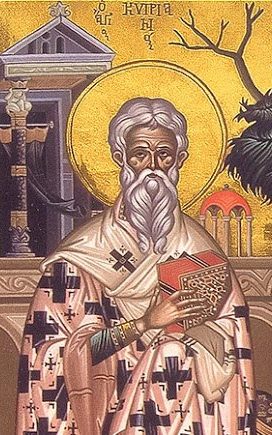
Cyprian had a different approach. He was bishop of the city of Carthage, in modern day Tunisia, which was the heart of the early African church in the mid-third century. Those were hard days of persecution for the church—under Decius from 250–51 and then again under Valerian between 257–60. But they were tough days for Rome’s entire Mediterranean empire more generally. Amid a protracted period of economic, political, and military crisis in the third century, a devastating plague broke out in the 240s. Cyprian described the effects in graphic terms:

This trial, that now the bowels, relaxed into a constant flux, discharge the bodily strength; that a fire originated in the marrow ferments into ulcers of the throat; that the intestines are shaken with a continual vomiting; that the eyes are on fire with the injected blood; that in some cases the feet or some parts of the limbs are taken off by the contagion of diseased putrefaction; that from the weakness arising by the maiming and loss of the body, either the gait is enfeebled, or the hearing is obstructed, or the sight darkened.

Rather than exhorting Christians to stock up on toilet paper and wash their hands—or whatever the non-anachronistic analog would have been—Cyprian cast this moment as an opportunity for them to demonstrate the sufficiency of God’s grace to them. “This finally is the difference between us and the others who do not know God, that they complain and murmur in adversity, while adversity does not turn us from the truth of virtue and faith, but proves us in suffering.”

Adversity does not turn us from the truth of virtue and faith, but proves us in suffering.

Cyrpian of Carthage

He even encouraged believers who had contracted the disease to see the foul experience as contributing to their sanctification. “What greatness of soul,” he remarked, “it is to fight with the powers of the mind unshaken against so many attacks of devastation and death, what sublimity to stand erect amidst the ruins of the human race and not to lie prostrate with those who have no hope in God, and to rejoice rather and embrace the gift of the occasion.”

Those who are “advancing to Christ by the narrow way of Christ” need not fear. We may well die—indeed, we certainly will unless Christ comes first—but our hope and home is in the heavenly places where we are, even now, seated with Christ (Ephesians 2:6; Colossians 3:1). Death is not our dread lord. But we might expect those who have no hope beyond this world to fear its grasp.

Cyprian invited his readers—and me as I read him; us if we will hear him—to reorient our perspective on this world and our place in it. For him, the plague, “horrible and deadly” as it was, had a “necessary” role to play: it “searches out the justice of each and every one and examines the minds of the human race.” That is, it caused people’s true colors to shine through as they determined how to act once the idols of their hearts were exposed.

The Coronavirus could do the same for us. It could be an opportunity for us to see our idols clearly, maybe for the first time, and to turn away from them and demonstrate that believing in Christ changes the way we live.

Are we caring for the sick? Are we extending hospitality? Are Christian employers showing compassion to their employees? Are Christian physicians caring for those who need help? Are the violent and greedy and proud among us changing their ways in the midst of this trial? Are the wealthy—even those who are infected—giving more to help those in need? Or are we too busy stocking up on Purell and facemasks? Are we, like the man Jesus described in Luke 12, more worried about filling our storehouses than we are about sharing with those who suffer? These are the sorts of questions that Cyprian asked of his readers. In doing so, he challenged them to treat the plague like an opportunity to “gladly seek martyrdom” and to “learn not to fear death.”

Please don’t misunderstand. Cyprian wasn’t telling his audience to intentionally catch the plague in order to become martyrs. He wasn’t one to urge irresponsible behavior, and I’m not either. There’s great wisdom in us loving our neighbors by behaving in ways that will slow the spread of the Coronavirus, and we should always count the cost for those who rely upon us before we put ourselves in harm’s way.

When the Decian persecution came to town Cyprian didn’t run to the Colosseum to offer himself to the lions. Rather, he went into hiding in order to continue his ministry among the suffering flock of Christ. But eight years later, when Emperor Valerian turned his wrath on those who would not confess Caesar as Lord, Cyprian found it was time to own Christ boldly. Urged by the proconsul Galerius to perform religious rites to the gods of Rome, the bishop refused and was sentenced to death by the sword. Cyprian thanked God as he went.

He understood that sometimes the Christian serves God by laying low; sometimes he serves God by standing tall. The same is true for us.

TLI believes that, right now, wisdom lies in temporarily pulling back from overseas travel, out of love for our neighbors and respect for our public health officials. But this doesn’t mean our work is done. In fact, we’ll all need to prayerfully consider what love and wisdom look like going forward as we seek to honor God in our specific callings and, more generally, be salt and light to those around us. But this is certain: citizens of the city whose Builder and Maker is God do not honor him by whimpering and huddling about. At this time we need the heavenly courage and compassion on display in Cyprian’s life.

Systematic Theology I: One and Three (Video 5)

This is the fifth video for the Systematic Theology course that I recently taught in S. Asia. Here we talk about what it means to confess that God is one while also confessing that the Father is God, the Son is God, and the Holy Spirit is God. This is a huge topic—the biggest one in Christianity—and while God’s unity and trinity is a basic element of the church’s confession, it is by no means simple.

To give credit where it’s due, this video by Red Pen Logic inspired my interaction with the “Are you there God?” meme. I thought it was a really clever way to push the students to wrestle with the question, “How would I respond to something like that?”

Sometime next year, Deo volente, I’ll get to teach an entire course on the Triune God to the same group of students. I’m eager to do this, partly because I’ve really enjoyed studying the doctrine of the Trinity; it has increased my faith and love for God in some unexpected ways. But I’m also aware that, in the context in which these students will be ministering as pastors, they’ll be facing unitarian monotheism on the one side and widespread polytheism (blending into pantheism) on the other. These are huge challenges, which make it all the more important for them to learn to faithfully confess the God who is one in essence and three in persons, so that they can faithfully proclaim that God to their people.

Mission Beyond the Pacific

Note: This article first appeared on the TLI website as the second in a four-part series about diaspora ministry. (Here is the first article in the series.)

The Presbyterian Church founded the Japanese Presbyterian Mission in San Francisco in the 1880s. Their immediate goal was to reach the issei—Japanese immigrants to North America—who had recently begun to appear in large numbers along the California coast.

Their arrival was an unintended consequence of international politics and global commerce. American Commodore Matthew Perry and his fleet forced Japan to “open” itself to the Western world in 1853. The opening went both ways, and thousands ended up coming to the United States via the West Coast. Most imagined themselves as temporary transplants. They planned to find work, make money, save up, and go home.

Called to Stay 

In July 1886, the Presbyterian Board called Dr. Ernest Sturge to serve as missionary to the Japanese in California. The Sturge family, formerly medical missionaries to Thailand and China, were on home-leave in San Francisco recovering from cholera. They thought they might continue their medical ministry among the Chinese in the Bay Area, but that work was already overstaffed with doctors.

Instead, they were shuffled toward the Japanese mission. Sturge worked tirelessly against anti-Japanese discrimination in the U.S., made multiple visits to Japan, and learned the language. He respected not only the people to whom he was called but their culture as well, even publishing a collection of sermons for “samurai for Jesus.” On the occasion of his fifteenth anniversary of work at the mission, friends published a volume of his poems and addresses. A recurring theme is he appreciated all things Japanese. This attitude earned the admiration and affection of the issei.

Sturge also knew that his skin tone and bushy mustache counted against him in this work. He was and would always be something of an outsider, both physically and culturally. To be sure, he sacrificed selflessly—the epitaph erected by Japanese friends noted his willingness even to give his own home over to their use. But he recognized that Christian leadership had to arise from within the Japanese diaspora community for the mission to grow and flourish.

To believe in Christ, they needed to hear him preached, preferably by issei preachers who could seamlessly communicate and apply gospel truths in their heart language as cultural insiders. So Sturge devoted part of his energies to training some of the first ordained Japanese clergy at the San Francisco Theological Seminary, which also served as the headquarters of the mission. Sturge sent these co-laborers out to plant a series of fourteen missions up and down the West Coast.

One of them in Wintersburg Village (now Huntington Beach) was founded in 1904. It constituted the first effort to reach the Japanese population of Southern California. The neighboring Presbyterian Church in Westminster threw its support behind the effort. Rev. Hisakichi Terasawa, a Japanese Episcopalian minister formerly of Osaka but laboring as part of Sturge’s mission in San Francisco, was dispatched to organize the early work. The community of Japanese chili pepper and celery farm workers, mostly bachelors with nowhere else to go and not much else to do, began meeting in a barn on Sundays for worship and fellowship.

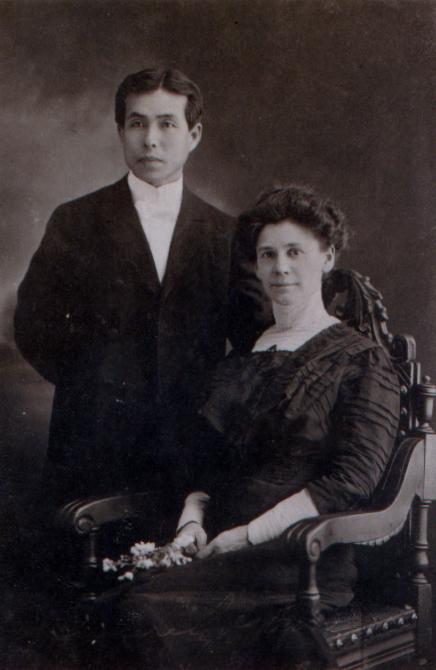
Rev. and Mrs. Inazawa (ca. 1912)

In late 1910, a manse and sanctuary with space for twenty-five was dedicated as the Wintersburg Japanese Presbyterian Mission, and Rev. Joseph Kenichi Inazawa, a former student of Sturge’s at the San Francisco seminary, was called as founding pastor.

The church sat on a half-acre of property owned by Charles Mitsuri Furuta, the first Japanese baptized in Orange County. It had been funded by the combined efforts of the congregants themselves and the members of nearby Presbyterian and Methodist congregations, who recognized the importance of reaching their neighbors for Christ. They wanted to see conversions and discipleship among the issei but also hoped that reaching them might promote kingdom growth in Japan.

When Sturge tried to communicate his vision for what these little missions among California’s Japanese diaspora community might become, he challenged his readers to expand their horizons beyond the West Coast of the United States. In order to see the significance and potential of diaspora ministry, they needed to look “beyond the Pacific.” So do we.

In order to see the significance and potential of diaspora ministry, they needed to look “beyond the Pacific.” So do we.

The Work Is One

Sturge explained: “The work at home and abroad is one. Whatever we may do to make our own land more Christian will influence other countries.” And sure enough, Sturge reported in 1895, some who converted and matured as believers in Orange County saved their money and returned to their homeland, “to exert a helpful influence in the cause of the Master” as ministers, leaders, and members of the church there. But many more ended up staying. They put down roots and built a community.

The Wintersburg Mission continues today, more than a century after its founding. Its members weathered racial prejudice, discriminatory legislation, and the internment of more than eighty members—including pastors and elders—during World War II. But the Lord sustained them, and they emerged stronger than ever. In 1930, they dropped the word “mission” and particularized as an independent Presbyterian congregation. In 1965, they relocated to Santa Ana to accommodate a growing congregation. Nowadays, Wintersburg Presbyterian Church is the largest Japanese-American congregation in the United States and a force for missions at home (especially among Orange County’s Asian-American populations) and abroad, supporting kingdom work in Japan and around the world.

There’s a two-part lesson worth learning here about diaspora ministry. First, as Sturge said, this work requires broad vision. A few enclaves of poor celery farmers may not have seemed likely to yield much of a harvest, but by “looking beyond the Pacific” Sturge and others imagined what the Japanese Presbyterian Mission might become. Our vision for the nations among us calls for an equally expansive horizon as we look toward that day when the earth will be filled with the knowledge of the glory of the Lord as the waters cover the sea (Habakkuk 2:14).

But second, if the goal and value of diaspora ministry are clear, we must remember that our return on investment may not match expectations—and that’s not a bad thing. The Japanese Presbyterian Mission’s vision was to reach the people of the Japanese mainland through the diaspora farmers and thereby win that nation for Christ. This hasn’t happened.

We don’t know what God has planned for Japan, but so far, we haven’t seen the spectacular growth of Christianity there that has occurred elsewhere over the last century. Perhaps we’ll never see it. That doesn’t mean there’s been no fruit, of course. Along with many others, Wintersburg continues to labor in Japan. But the principal harvest of that church’s ministry has been closer to home, and it’s been abundant.