Reading CCR: All We Need and Altogether Necessary (§I.ix-x)

For Scripture is so holy and perfect, abundantly containing whatsoever is necessary for salvation, that nothing can be added to it, and it is also so perfectly and prudently composed that nothing can be taken away from it.

Girolamo Zanchi, Confession of the Christian Religion, §I.ix

Now Zanchi continues with his description of the character of Scripture. In §I.i-viii, he’s told us what we as members of the church confess about the clarity, authority and preservation (or integrity) of God’s written word. Now, in a tightly packed sentence, he emphasizes a few more of Scripture’s “properties” (as they’re called): its holiness, necessity, and perfection.

Most of these properties were not hotly debated in the late sixteenth century, so they didn’t require much more than a simple statement. But because of the debate with Rome, the property of authority called for a much more detailed articulation (§I.v-x). Similarly, perspecuity will also receive some elaboration (§I.xiii).

Peter van Mastricht (1630-1706)

Peter van Mastricht, writing downstream of Zanchi by a century, offers a slightly longer but still concise description of the properties of Scripture in the prolegomena to his Theoretical-Practical Theology (§1.1.2; pp. 126-30).

Mastricht organizes the properties into slightly different categories (authority, truth, integrity, sanctity, perspecuity, perfection, necessity, and efficacy) and describes them in greater detail. But I don’t see dramatic differences between what he and Zanchi are trying to communicate about the word of God.

The basic points that Zanchi wants to draw out here is 1) Scripture gives us everything that we need to know for our salvation and 2) Scripture works as an integrated whole. It’s all of a piece and perfectly wrought, so we don’t need anything more and anything less wouldn’t do.

Thus, we submit to the teaching of the holy Scriptures, just as all the devout ought, holding to what the Apostle said: “All Scripture inspired of God is useful for teaching” and so forth (2 Tim. 3:16).

Girolamo Zanchi, Confession of the Christian Religion, §I.x

Given what has been confessed about the nature and character of Scripture, the obvious next thesis is, of course, that “we must submit” to what it says. This can’t be a controversial conclusion for anyone who has acknowledged what preceded. But, to reorient our minds in the light of Scripture itself, Zanchi rightly turns us toward 2 Timothy 3:16 where we are reminded that every word of God-inspired Scripture is “useful for teaching, for reproof, for correction, and for training righteousness, that the man of God may be complete, equipped for every good work.”

If the Scriptures are holy and God-breathed, then we must soften our hearts and bend our knees. That doesn’t meant that submission is easy or that we always know exactly what submission looks like. But, as noted in a previous post, the posture of God’s people before him (and, so, before his word) should default to humility. The fear of the Lord—not slavish, cringing fear, but awe-ful reverence before the one who stands in authority over us—is the beginning of wisdom (Prov. 9:10).

Systematic Theology I: Providence & Miracles

We’re coming into the home stretch on this Systematic Theology I course. This video digs into the works of God, focusing on God’s providence and its relationship to things like miracles, concursus, convergence, preservation, and so forth.

It turns out that the easy distinctions that we want to make between creation and providence don’t divide quite so neatly. But both are the good work of the good God working out his good plan.

For those following along at home, this video corresponds to Chapter 10 of Letham’s Systematic Theology.

This Splendid Banner: The Missional Vermigli

Just as nothing can equal your name, so we desire that it be both acknowledged and worshiped by all mortals. This will be done if, just as you often rescued your people from grave dangers, so in the present you look upon them, give them strength, and grant them true salvation when the enemies of human salvation rise up mightily against them. We beseech you to unfurl this splendid banner so that the opponents of your glory, after taking notice of it, may earnestly be converted unto you. Through Jesus Christ, our Lord. Amen.

Peter Martyr Vermigli, Sacred Prayers from the Psalms of David (pp. 82-83).

Peter Martyr Vermigli (1499-1562) is one of the greats of the Protestant Reformation. His influence—personal, through his writings, and by way of his students—had a profound impact throughout Protestant lands as well as in significant portions of Roman Catholic Europe as well. As the first and most significant mentor in Zanchi’s life, he also has a special claim on my affections.

Vermigli’s prayers on the Psalms are a fascinating window into his heart and theology… as well as a delightful devotional supplement for anyone reading through the Psalter. It’s not clear when, precisely, he wrote the prayers, since they were only found and published after his death, but they give a great deal of internal evidence that they were penned during a period of persecution and suffering for the reforming churches.

Vermigli himself was twice an exile for the Gospel, first from his native Italy (with the Inquisition on his heels) and then again, in the mid-1550s, from England when Mary Tudor came to the throne. This second exile was preceded by his arrest, six month’s imprisonment, and the very real threat of execution. In other words, Vermigli’s prayers came from a place of suffering and uncertainty about what this life would bring. They often call upon God to remember those who look to him for their salvation, despite their many sins, for his own name’s sake. Seeing this impulse in Vermigli’s prayers is not surprising.

What is surprising is the emphasis on what we would now call “missional thinking.” The Reformation is often accused of being lukewarm about taking the gospel to the nations. But if PMV is any indication, maybe we need to do some rereading.

Over and over, Vermigli calls upon God to see to the ever increasing proclamation of his goodness and inexhaustible kindness to all peoples (Ps. 93), the extolling of his name everywhere that all peoples might adore and reverence the divine majesty with pure worship (Ps. 96), the refreshing of the downtrodden so that God’s fairness and justice might shine forth as widely as possible to all people (Ps. 98), and on and on and on.

If the ultimate goal of Vermigli’s prayers was God’s glory, then their penultimate goal was very often framed in terms of the fulfillment of the Great Commission. He saw the expansion of Christ’s kingdom to the ends of the earth as, perhaps, the primary way in which God would get the glory.

But, Vermigli believed, that expansion would only happen as God overthrew the church’s enemies. He cast that divine rescue as the “splendid banner” that, being seen by all people, would cause them to be astonished (Ps. 86). As God strengthened and delivered his people by the power of his hand, then the nations would see and know, then the church’s witness to their own enemies and to the nations would be compelling.

As Psalm 126 puts it, “When the Lord restored the fortunes of Zion, we were like those who dream. Then our mouth was filled with laughter and our tongue with shouts of joy. Then it was said among the nations, ‘The Lord has done great things for them.’ The Lord has done great things for us; we are glad.”

Vermigli wasn’t really interested in what we now call missions. I doubt that he had any concrete plan in mind for reaching unreached people groups. He wasn’t thinking about sending agencies or support raising or the complexities of cross-cultural ministry. In terms of ministry energy, he was more focused on the lost around him—the millions of people placing their hope in a false gospel—than he was on converting China or India. But make no mistake, he earnestly prayed that the Lord would bring reform to the church and end its suffering at the hand of its enemies so that the ends of the earth might hear the Gospel preached and turn to Christ in faith.

We live in the wake of Vermigli’s prayers, and many of us enjoy remarkable freedom in sharing the Gospel as we go about our ways. We get to follow both the general and specific calls that God has set upon us without fearing exile, imprisonment, or execution. Thank God for his mercies.

Being a Christian isn’t easy and there’s suffering to be had, even in the land of plenty. But let’s remember the divine faithfulness that has time and again met the church in its need. Let’s testify to that faithfulness as we bear witness to what God has done and trust that he will be there in the future.

Systematic Theology I: Creation Ex Nihilo

In this video from the Systematic Theology I course that I taught a few months for a school in South Asia, we delve into the works of God. For the sake of clarity in discussion, the works of God (“ad extra”) are often distinguished into three categories: the divine decree, creation, providence.

This video gives an overview of all three of these as I try to emphasize that God’s words and works flow from his being, but then we focus in on creation, particularly what is known as creatio ex nihilo.

We definitely want to affirm creation ex nihilo—”from nothing”—because otherwise we get a vision of God and creation that doesn’t fit the biblical witness—materialism, pantheism, interdependent dualism, deism. None of these will do.

Reading CCR: Come and See (§I.vi-viii)

Zanchi has already confessed that the canon of Scripture is the normative authority which alone can be used to prove the “tenets of the faith” (§I.v). But now he’s going to circle back around because he wants make sure that we state the proper relationship between the authority of Scripture and the authority of the church in a very clear fashion.

That relationship was one of the major presenting issues that sparked the Protestant Reformation in the 16th century. Which came first, the church or the Bible? Rome argued (and still does) that the church decided which books accorded with apostolic teaching and which did not. It conferred authority upon the Bible and, therefore, the Bible’s authority stands under the authority of the church, especially via unwritten apostolic traditions handed down to bishops. The pope, as earthly head of the church, exercises interpretive authority.

The Reformers said, as Zanchi puts it, that “the canonical books do not receive their authority from the church” (§I.vi). From generation to generation, as the church listened to the Holy Spirit and to the prophets and apostles who set down the Word of God, she has accepted, received, acknowledged, and declared which books are canonical and which not. But all of those actions testify to the church’s submissive posture before the Bible. Why? Because Scripture’s authority comes from the fact that it is God’s word.

[T]hese writings neither receive nor have their authority from [the church], but only from God, their proper author. Therefore, of themselves, because they are the word of God, they have authority [ius] over everyone and are worthy to be believed and obeyed by everyone simply.

Jerome Zanchi, Confession of the Christian Religion, §I.vi

Nevertheless, the church bears witness to the Scripture as the word of God. We testify that we hear in them God’s voice in the hope that, as we do, others will be moved by the authority of the church to “hear and read the holy Scriptures as the word of God” (§I.vii).

In offering this testimony to the living word of God, the church doesn’t “add something or take something away” from it (§I.viii). Nor does the church have the power to bring life to a stony heart. That’s the work of the Spirit who gives faith through the proclamation of the law and the gospel. But, like the Samaritan woman who invited her neighbors to “come, see a man who told me all that I ever did” (Jn. 4:29), the church uses whatever relational capital it can muster to turn people toward the source of living water (v. 10).

Sts Augustine and Ambrose, by Fra Filippo Lippi

In a passage cited by Zanchi on this point, Augustine famously declared that he “would not have believe the gospel, had not the authority of the Church” moved him to it. Which gets us to the question that I hope we will all wrestle with: Do the local congregations of Christ’s church in which we participate have that sort of authority? Would someone coming in for the first time at the invitation of a coworker or family member be drawn to respond to the bold proclamation of the gospel on the basis of the church’s testimony? Or has the church become a stumbling block to belief. If the latter, what can we do as individuals and communities to change that?

Zanchi’s mentor Peter Martyr Vermgli (1499-1562) left behind a powerful collection of prayers drawn from the psalms. I’ve been convicted by how often he connects repentance and godliness within the church to her faithful and fruitful witness among the nations. Let’s pray for reformation within the house of God so that we can be credible witnesses to our Lord when we say to our neighbors, “Come and see.”

Systematic Theology I: Interpretation of Scripture (Video 10)

This continues the series of videos from a recent ST1 course that I taught remotely for a seminary in S. Asia. We’re continuing to work on the doctrine of Scripture. Here we consider, in particular, how it is that we interpret Scripture.

My approach is from 50,000′ and doesn’t get into the weeds of genre theory or parsing verbs. Really, my major point is that we read Scripture as part of a community. That means that we don’t try to reinvent the theological wheel every time we come to the Bible. Instead, we listen humbly to what the church has said even as we test what it says by measuring it against Scripture.

Reading CCR: Learning to Love the Apocrypha? (§I.iii-v)

There’s a second half to CCR §I.iii that takes up the distinction between canonical and apocryphal books. The former are those that have been accepted everywhere, always, and by all the church as theopneustos (God-breathed) because, as Barclay put it, “no one could stop them.” But what about those that were “less evident[ly]… from the Holy Spirit”? Here’s Zanchi’s answer:

The other books, although they are contained within a volume of the holy books [in volumine sacrorum bibliorum], she nevertheless calls Apocryphal, because it is less evident that they are from the Holy Spirit than the other ones.

Girolamo Zanchi, Confession of the Christian Religion, §I.iii

This is a bit of a surprise to me. Zanchi’s rationale for calling books like Judith, Tobit, and Ecclesiasticus [sic] apocryphal is not that they are heretical or confusing or came later than the canonical OT books. Instead, he highlights that it is “less evident” to the church that they are theopneustos. Well, the Western Roman and Eastern Orthodox Churches would disagree, I suppose. But Zanchi has the rabbis on his side as well as Jesus and the apostles, who never quote from or paraphrase apocryphal books.

It turns out that it was not unusual for Reformation and post-Reformation Protestants to have a high opinion of the Apocrypha even as they distinguished it from the biblical canon. In taking this approach, they followed the Church Father Jerome (c. 342-420), who drew a line between OT canonical books and ecclesiastical books, the latter being apocryphal. (This article by David Briones is useful here.)

So, in one sense, Zanchi isn’t doing anything unusual. He likes the Apocrypha but knows that it’s not canon. Although he gives the apocryphal books “the first place after the canonical books,” he confesses that we should “use only the canonical books for proving the tenets of the faith” (§I.iv-v). Even Zanchi’s assertion that, after a point of faith has been proven from Scripture, apocryphal texts “have no little authority” as subordinate and confirming authorities (§I.v) can fit within this approach.

Yet Zanchi sure seems to go beyond saying that apocryphal books are beneficial, holding out the possibility that they are, in fact, theopneustos. It’s just that their Spirit-breathed character was “less evident” to the church, which therefore did not recognize them as Scripture. In other words, as Barclay might have put it, these books could be stopped.

So can revelation be the very word of God but not be canonical Scripture? Well, yes, depending on how we use “canonical.” Francis Turretin gives a bit more clarity when he explains an Augustinian distinction:

For [Augustine] makes two orders of canonicals: the first of those which are received by all the churches [“the canon of faith”] and were never called in question; the second of those which are admitted only by some [“the canon of ecclesiastical reading”] and were usually read from the pulpit. He holds that the latter are not to be valued as rightly as the former and have far less authority.

Turretin, Institutes of Elenctic Theology, I:104 (2T, Q9.VII)

Can revelation be God-breathed but not canonical in the narrower sense? Well, maybe. This is probably the case with Paul’s letter to the Laodiceans (Col. 4:16) or the Book of the Wars of the Lord (Num. 21:14), both of which are lost, which clearly indicates to us that the Lord determined that whatever those books contained was not necessary information for the salvation and flourishing of the entire church. The “canon of faith” was complete without them.

But here Zanchi (and Turretin) is speaking of books that we still possess. His point is that the very fact that God’s people have not always and everywhere discerned them as God’s word demonstrates that they are not canonical in Turretin’s narrower sense, even if they may be theopneustos and canonical in Turretin’s wider sense..

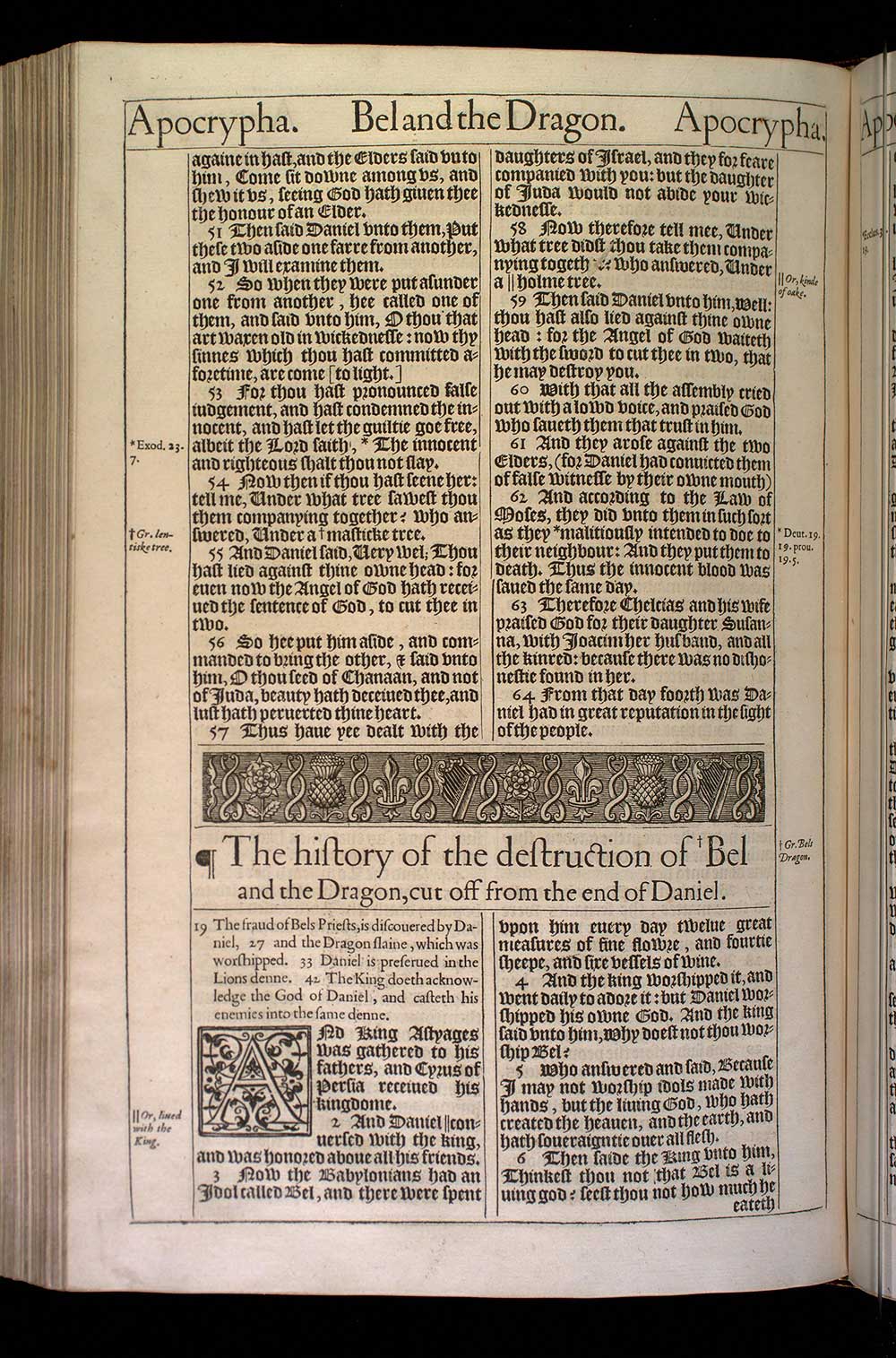
There are some things about this approach that are helpful. For example, it makes sense of why some early congregations accepted The Shepherd of Hermas or the Didache as special revelation even though the whole church never received them as canonical. But this is a difficult road to walk—Danger on all sides!—because the church has not always been content with the 66-book canon that we receive. How do we know that we aren’t missing the canonical boat by labeling Bel and the Dragon merely as apocryphal?

“How do we know?” So many of our questions come back to that issue of certainty. It’s the curse of the Enlightenment and its post-modern grandchild at work. Zanchi wasn’t unaware of the need to address this question but he also wasn’t obsessed with it in the way that we tend to be. How did he know that Bel and the Dragon was “out”? God’s OT church hadn’t recognized it. Jesus and the Apostles did recognize it. The post-apostolic church had doubts about it. It didn’t sound like Scripture. It didn’t claim to be the word of God. All this didn’t make the Apocrypha bad or useless. It just made it non-canonical.

Systematic Theology I: Scripture and Tradition (Video 9)

This ninth video in my recent systematic theology course for an amazing school in S. Asia gets into a question that I’ve been thinking about a fair amount lately, the relationship between Scripture and tradition. We Protestants sometimes get confused about how authority works and, unfortunately, can be inclined to through out the baby with the bathwater. That is, we sometimes imagine that since the Bible is the very word of God, why would we need to listen to any other authorities? “Away,” we say, “with creeds and councils and theologians and all their stuffy books!”

Well, perhaps not surprisingly, I take a different path in this video. I argue that we do well to listen humbly to authorities that proclaim the same gospel as Scripture proclaims.

By the way, I found most of the chapters in Reformed Catholicity by Scott Swain and Michael Allen to be helpful in thinking about this topic.

Reading CCR: Can’t Stop This (§I.iii)

The canonical books alone are the prophetic and apostolic writings.

But we do not doubt that the prophetic and apostolic writings are those which the church of God is accustomed, for that reason, to call by the name of the canonical books, because, knowing with certainty that these books are θεόπνευστος [God-breathed] (2 Tim. 3:16), she has always acknowledged them alone as canon of all Christian piety, according to which all religious controversy must be tried.

Girolamo Zanchi, Confession of the Christian Religion, §I.iii

Having confessed that the God who reveals has revealed himself to the prophets and apostles as well as to us through their Spirit-inspired writings (which are the “very word of God” [§I.ii]), Zanchi now has to say something about which writings are”canonical” and which aren’t.

God did not simply drop the Bible down from heaven. Instead, he chose to reveal himself through prophetic and apostolic authors. Zanchi doesn’t have much to say here about how God did this, since it wasn’t a matter of serious contention until later in church history.

What he does want to focus on is the the fundamental criterion for canonicity, which is that the books in question are theopneustos or God-breathed. If such God-breathed writings exist and if the church can recognize them as such, then they are the measuring stick (which is all that “canon” means) for “all Christian piety” and “religious controversy.” Not surprisingly, his next move in CCR will be to list all the books that the “whole church… acknowledges and embraces, without any doubt,… as most certainly the word of God” (§I.iv).

But where, you ask, does the church fit in? After all, Dan Brown convinced millions that church leaders gathered at the Council of Nicea chose which books got to be in the Bible. Fortunately, Zanchi never got around to reading The Da Vinci Code.

To be sure, CCR affirms that the church calls specific books canonical and other not, but it makes this distinction not because it claims a magisterial authority that binds (or looses) books to (or from) the canon. Rather, the church’s authority is ministerial. The church is accustomed to call Spirit-inspired books written by prophets and apostles canonical because (“for that reason”) they are theopneustos, which is to say “the very word of God” (as Zanchi put it §I.ii).

Needless to say—at least, I wish it were needless to say (but, things being as they are…)—this is not the same thing as saying that the church decides which books are the very words of God or that it confers an inspired status upon the Bible.

Books don’t gain or lose canonical status on account of the church’s recognition (even if the testimony of the church on their behalf may be important in convincing individuals to believe (as was famously the case for Augustine); they are canonical, so the church recognizes them.

Bruce Metzger

Bruce Metzger comments:

Neither individuals nor councils created the canon; instead, they came to recognize and acknowledge the self-authenticating quality of these writings, which imposed themselves as canonical upon the church.

The New Testament, Its Background, Growth and Content, p. 318

William Barclay put it succinctly: “The New Testament books became canonical because no one could stop them doing so” (Making of the Bible, 78).

With that important clarification in mind, let’s take a moment to wonder at the fact that God gave the church the work of gathering together into a single volume the inspired writings that he chose to be included in the canon of Scripture. Like sheep that know the voice of their Shepherd, the Spirit-guided church recognized the voice of her God and responded. Because she hears that voice in books of the Bible, she recognizes them the canon, the ruler that measures theology, piety, and practice.

Systematic Theology I: Inspiration (Video 8)

This eighth video (of 14 total) created for a recent Systematic Theology I course moves us from theology proper to the doctrine of Scripture or, more broadly, of revelation. I think it’s probably more typical to address the revelation before God (often as part of a “prolegomena“), but the textbook that we worked with for this course chose to do things a bit differently.

There’s always a tension, I think, about where you begin in a theological system: with the God who gave Scripture or the Scripture that tells you about God. Wherever you begin, the desirable thing would be to describe a God who intentionally makes himself clearly known in meaningful ways that also correspond to the way things actually are. The Great Tradition of Christian theology has said that the Bible is that sort of divine revelation on account of God’s work of inspiring (or, maybe better, his out-breathing). That’s the basic path that I try to follow here.